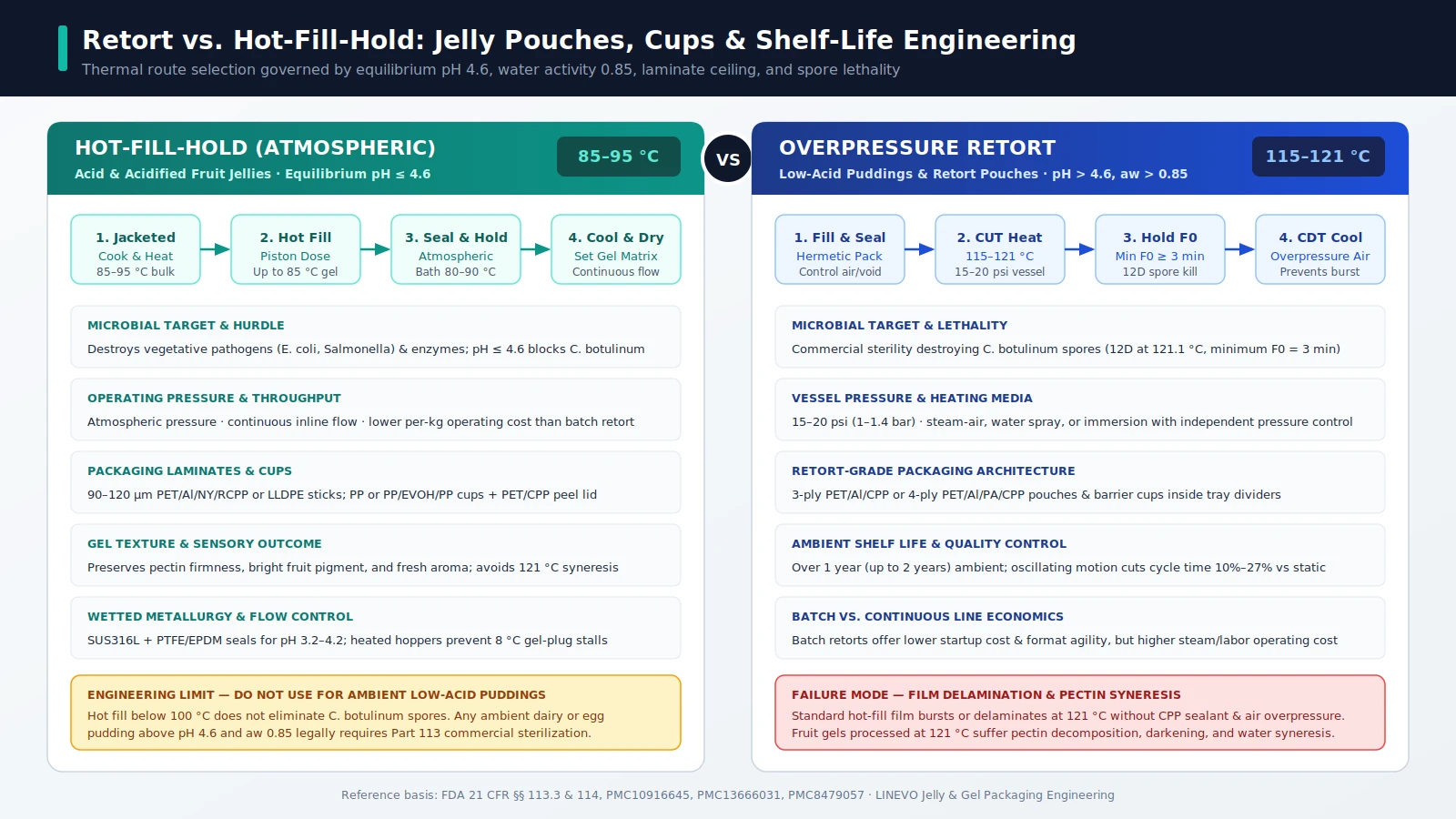
Hot-fill-hold stabilizes acid and acidified fruit jellies (pH 4.6 or below) at 85–95 °C and atmospheric pressure to protect pectin texture, while overpressure retort sterilization processes hermetically sealed low-acid puddings (pH above 4.6, water activity above 0.85) at 115–121 °C and 15–20 psi to destroy Clostridium botulinum spores for up to 2 years ambient.
What Is a Retort in Commercial Food Processing?
Under federal low-acid food definitions in § 113.3, a retort is any closed vessel or thermal processing equipment used to commercially sterilize hermetically sealed food containers. Commercial retorts—also called autoclaves—heat sealed pouches, cups, jars, or cans at 240–250 °F (115–121 °C) under 15–20 psi (1–1.4 bar) above atmospheric pressure to achieve room-temperature stability for up to 2 years.
Because commercial sterility must eliminate viable microorganisms including spores of public-health significance, retort thermal schedules are designed around Clostridium botulinum spore lethality. Using Stumbo’s benchmark D121.1 value of 0.21 min at 121.1 °C (250 °F), the established Fo benchmark equals 2.52 min; since 1965, low-acid shelf-stable food processors have applied a minimum botulinum cook of F0 = 3 min at 121.1 °C for a 12D spore reduction.
| Engineering Criterion | Hot-Fill-Hold (Atmospheric) | Pressurized Overpressure Retort |
|---|---|---|
| Equilibrium pH & Water Activity | Acid or acidified foods at pH 4.6 or below | Low-acid foods above pH 4.6 and water activity above 0.85 |
| Thermal Processing Window | 85–95 °C fill/hold (or up to 85 °C fill + 80–90 °C water bath) | 115–121 °C (240–250 °F), extending up to 130 °C in pressurized cycles |
| Operating Pressure | Atmospheric pressure throughout dosing and cooling | 15–20 psi (1–1.4 bar) above atmospheric plus cooling overpressure air |
| Microbial Inactivation Target | Vegetative pathogens, spoilage flora, pectinases, and polyphenol oxidase | Viable public-health and spoilage organisms including bacterial spores (12D, minimum F0 = 3 min) |
| Packaging Structure | 90–120 micron PET/Al-Foil/NY/RCPP or LLDPE sticks; PP or PP/EVOH/PP cups + PET/CPP peel lid | Three-layer PET/Al/CPP or four-layer PET/Al/PA/CPP retort pouches and barrier cups |
| Typical Ambient Shelf Life | Acid-stable ambient distribution without refrigeration | Over a year, extending up to 2 years at room temperature |
| Texture Impact on Fruit Gels | Preserves pectin gel strength, color, and fresh flavor | 121 °C exposure causes pectin decomposition, darkening, and water syneresis |
What Is Hot Fill and How Does It Stabilize Acidic Fruit Gels?
Hot-fill-hold heats acid or acidified liquid and gel formulations to 85–95 °C—such as 90–95 °C for 30 s—before dosing hot into containers and sealing immediately at atmospheric pressure. Product acidity at equilibrium pH 4.6 or below prevents Clostridium botulinum spore growth, so sub-boiling heat only needs to destroy vegetative pathogens, spoilage microbes, and enzymes.
Under federal acidified-food rules in Part 114, natural acid foods hold a pH of 4.6 or below, while acidified foods are low-acid bases adjusted with acid to water activity above 0.85 and finished equilibrium pH of 4.6 or below—a category that explicitly covers acidified puddings. Under § 114.80, acidified foods must receive sufficient thermal processing to destroy vegetative cells of public-health and spoilage microorganisms capable of reproducing during storage and retail. Standard 85–95 °C pasteurization and hot-fill-hold schedules eliminate vegetative pathogens, as well as quality-degrading enzymes such as pectinases and polyphenol oxidase, though thermotolerant acidophilic spores can survive sub-boiling hot-fill treatments and require strict raw-fruit sanitation.
Key regulatory and formulation guardrails separate compliant hot-fill lines from costly failures:
- Potentiometric pH Verification Above 4.0: Under § 114.80, whenever an acidified dessert’s finished equilibrium pH exceeds 4.0, final equilibrium pH must be verified by a potentiometric method, and in-process titration or colorimetry must be correlated to that reading. Under § 114.89, any batch that deviates from its scheduled process or finishes above equilibrium pH 4.6 must be reprocessed, thermally processed as a low-acid food under § 113.3 rules, evaluated by a competent processing authority, or destroyed.
- Thermal Ceiling of Pectin Fruit Gels: Pushing an acid fruit gel through a 121 °C retort unnecessarily destroys product quality. Published heating trials on fruit paste pressurized at 121 °C for 4 min and 20 min recorded dark color shifts alongside visible water syneresis driven by thermal decomposition of pectin—confirming why fruit jellies at pH 3.2–4.2 stay on hot-fill dosing up to 85 °C paired with 80–90 °C atmospheric water-bath pasteurization.
- Viscosity and Acid Metallurgy Controls: Hydrocolloid jelly lines must maintain tight heat tracing because an 8 °C temperature drop inside an uninsulated feed pipe shifts a pumpable 600 cP gel into a semi-solid plug and pushes lane-to-lane weight variance past ±5%. For acidic fruit jellies at pH 3.2–4.2 formulated with citric or malic acid, product-contact wetted hardware specifies SUS316L stainless steel paired with food-grade PTFE or EPDM seals.
How Does the Retort Filling Process Differ From Hot-Fill-Hold?
Hot-fill-hold thermally treats bulk product before dosing hot into the container and holding at atmospheric pressure, whereas retort processing fills and hermetically seals the pouch or cup first and then sterilizes the closed package inside a pressurized vessel. Every retort cycle follows three distinct stages: come-up time (CUT), pressurized holding, and come-down time (CDT) cooling.
During CUT, high-flow heating media raise the closed vessel to 240–250 °F (115–121 °C) and 15–20 psi (1–1.4 bar) above atmospheric pressure. During the holding stage, temperature and pressure stay locked until the coldest point inside the package accumulates target lethality (at least F0 = 3 min for low-acid foods). Because in-pack sterilization transfers heat inward through the package wall, processors examine and control critical factors including initial product temperature, formulation viscosity, drained weight, and packing density—which should be 5%–10% more than nominal product weight—alongside vacuum and residual air levels before sealing.
How Overpressure Air, Tray Separators, and Agitation Protect Pouches
Flexible pouches and semi-rigid pudding cups behave very differently from rigid steel cans inside a 121 °C vessel. As cooling water enters during CDT, rapid vessel pressure drops cause trapped headspace gas and hot internal vapor to expand, which can burst pouch seams or deform semi-rigid cups. Commercial retort lines prevent burst failures by injecting counter-balancing overpressure air throughout cooling and stacking pouches between perforated crate separators that limit container expansion while keeping forced water or steam-air circulation channels open.
Vessel heating mode and basket motion also dictate cycle speed and pudding texture:
- Saturated Steam vs. Steam-Air and Water Spray: Pure saturated steam retorts suffer pressure fluctuations that make it difficult to run flexible pouches and semi-rigid trays without distortion or cold spots. Horizontal steam-air retorts provide forced circulation and independent temperature and pressure control built specifically for flexible foil pouches and semi-rigid containers, while water-spray and water-immersion retorts similarly balance external overpressure around delicate packs.
- Static Heat Lag vs. Agitated and Variable Retorting: Static retorts experience slow heat penetration and internal temperature zones that cause overcooking, uneven texture, and cooked off-flavor. Adding oscillating retort motion cuts calculated process time by 10%–27% compared with static mode at identical thermal settings, while variable retort temperature profiles (VRTPs) cut processing time by 20%–30% and improve surface quality by 5%–15%. In spore-inactivation trials, reciprocal agitation achieved a 7-log spore reduction in 17 min versus 53 min in static retorting.
What Packaging Film and Machine Specs Does a Retort Line Require vs. Hot Fill?
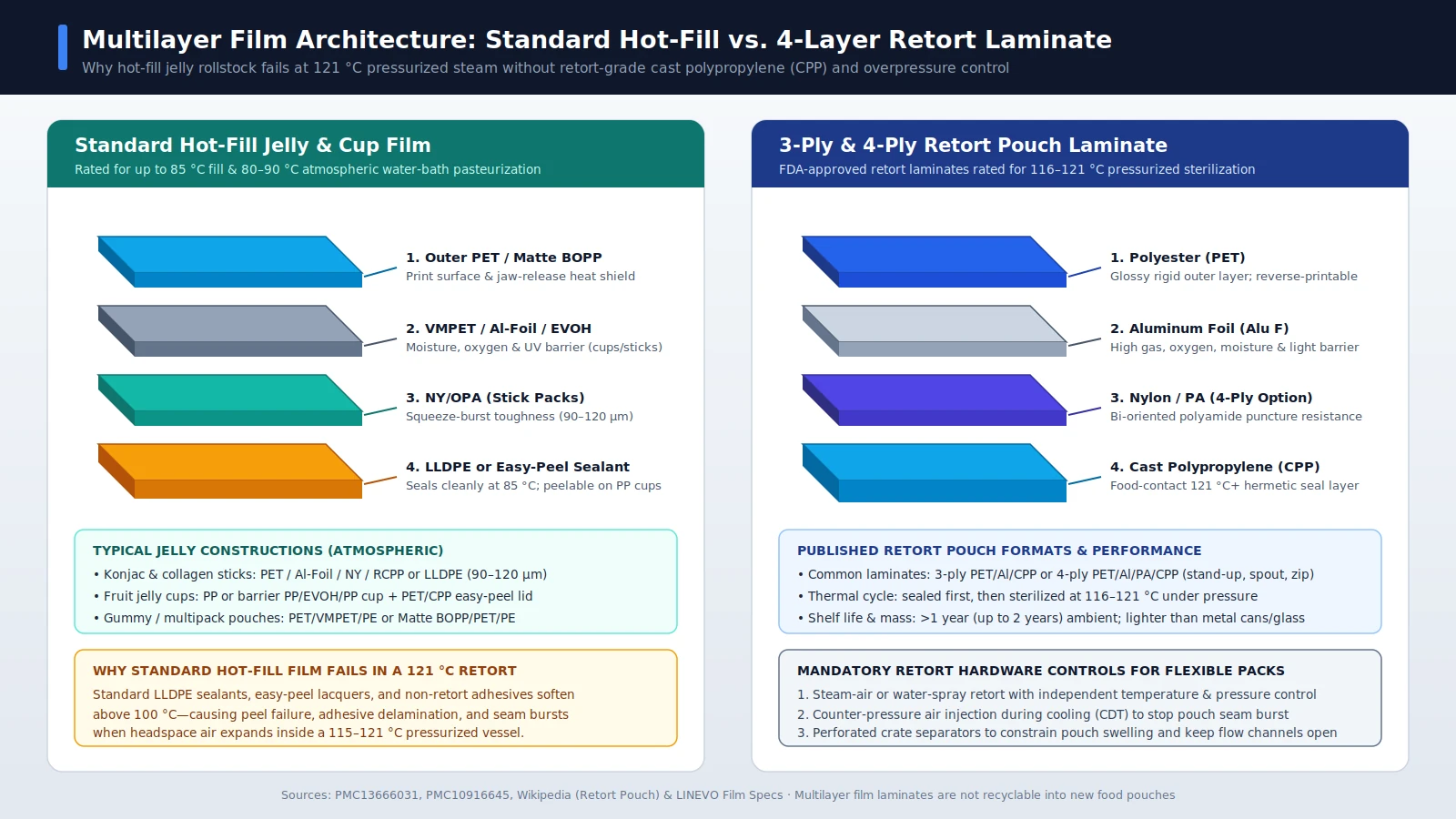
Retort lines require FDA-approved multilayer laminates built for 116–121 °C pressurized sterilization, most commonly three-layer PET/aluminum foil/CPP or four-layer PET/aluminum foil/polyamide (PA)/CPP structures. Hot-fill jelly lines use lighter atmospheric barrier films rated up to 85 °C fill and 80–90 °C water-bath pasteurization, such as 90–120 micron PET/Al-Foil/NY/RCPP or LLDPE sticks and PP/EVOH/PP cups.
Each ply in a retort pouch performs a distinct structural role during 116–121 °C pressurized cycles: outer polyester (PET) provides gloss, mechanical rigidity, and an inner-printable surface; bi-oriented polyamide (nylon/PA) provides puncture resistance; aluminum foil blocks oxygen, gas, and light permeation; and food-grade cast polypropylene (CPP) forms the high-temperature inner heat-sealing layer. Commercial retort pouches are supplied in stand-up, spout, and zip-lock formats, weigh less and require less manufacturing energy than metal cans, paperboard, or glass jars, and keep sterilized contents shelf-stable for over a year without refrigeration—though multi-material laminates cannot be recycled back into new retort food pouches.
Sending a standard hot-fill LLDPE sealant film or easy-peel cup lidding lacquer into a 121 °C retort autoclave causes softening, loss of seal strength, or pouch bursting under internal expansion. Matching laminate chemistry to the thermal cycle is therefore a non-negotiable engineering gate before ordering print cylinders or tooling.
| Packaging & Hardware Dimension | Hot-Fill-Hold Jelly Line | Pressurized Retort Pouch / Cup Line |
|---|---|---|
| Primary Pouch / Stick Laminate | PET/Al-Foil/NY/RCPP or LLDPE (90–120 micron) | Three-layer PET/Al/CPP or four-layer PET/Al/PA/CPP |
| Cup & Lidding Architecture | PP or PP/EVOH/PP cup + PET/CPP easy-peel lid | Barrier retort cup + high-temp CPP hermetic seal |
| Commercial Pouch Formats | Multi-lane sticks, four-side sachets, spout and stand-up pouches | Stand-up, spout, and zip-lock retort pouches |
| Operating Thermal Ceiling | Up to 85 °C fill contact; 80–90 °C atmospheric bath | 116–121 °C pressurized sterilization |
| Downstream Thermal Vessel | Atmospheric hold conveyor or water-spray cooling tunnel | Steam-air, water-spray, or immersion overpressure retort with crate separators |
| Hermetic Seal Requirement | Leak-tight hot seal supporting squeeze pressure | Hermetically sealed under § 113.3 to block microbial re-entry post-retort |
Matching Jelly Pouch and Cup Fillers to Thermal Film Ceilings
Upstream filling machinery must match both the container format and the thermal sealing specification. On dedicated premade pouch platforms, spouted drinking-jelly lines run 10–15 bags/min on the LV-160 spout pouch filler, while rotary premade stand-up pouch lines run 20–70 bags/min on the LV-210 across bag widths of 90–210 mm and lengths of 110–330 mm. High-output flat-sachet lines such as the LV-500SY, LV-700SY, and LV-980SY dose 5–100 ml across 2–16 lanes at 20–40 cuts/min using SUS304 frames and 0.6–0.8 MPa pneumatic systems.
To align dosing temperature, hopper heating, and film web geometry across your primary line, review our hot-fill jelly dosing and film specifications, compare premade pouch platforms on spout pouch and multipack jelly lines, check rollstock widths in the stick and cup film width chart, evaluate spray-zone cooling in our tunnel pasteurizer guide, or benchmark machine architectures in how to choose a jelly packing machine.
How Do Retort vs. Hot Fill Cost Drivers and Throughput Compare?
Continuous hot-fill-hold and indirect thermal lines operate without batch stops and deliver lower operating cost per kilogram than batch retorting, whereas batch retorts offer lower startup investment than continuous retorts or high-pressure processing (HPP) alongside multi-format flexibility—at the expense of higher steam venting peaks, crate-handling labor, and idle capacity between runs.
Peer-reviewed economic modeling by Cacace and colleagues comparing thermal processing routes against HPP illustrates how capital and operating expenses diverge: processing 1 kg of product via HPP cost 1.78 times as much as continuous indirect thermal treatment and 1.40 times as much as retort processing. In that comparison, retort processing carried the lowest initial startup investment by a wide margin, yet incurred a higher operating cost per kilogram than continuous indirect thermal treatment.
Across pouch and cup plants, four structural cost drivers separate the two architectures:
- Batch Gaps vs. Continuous Flow: Batch retorts process discrete loads with time gaps for crate loading, venting, holding, cooling, and unloading—driving peak energy and labor demand and lower individual retort utilization. Venting consumes the largest share of energy during the first minutes of a batch cycle, forcing multi-retort facilities to stagger schedules.
- Volume Threshold for Continuous Retorts: Small- to medium-sized facilities rarely justify the capital cost of a continuous or hydrostatic retort. High-volume factories running uniform container sizes without frequent changeovers gain lower labor, energy use, and downtime from continuous retorting, whereas hot-fill lines already run continuously at moderate output.
- Packaging Material Overhead: Moving from atmospheric hot-fill rollstock to three-layer or four-layer retort pouch laminates adds barrier and high-temperature CPP specification overhead, although flexible retort pouches remain lighter and lower-energy to manufacture than rigid metal cans or glass jars.
- Regulatory and Process-Authority Compliance: Low-acid retort operations under § 113.3 require scheduled-process validation, calibrated temperature-measuring devices, heat-distribution and heat-penetration studies, and hermetic seal verification, adding validation overhead beyond routine acid-jelly pH checks.
How Does Retort Processing Compare to UHT Aseptic Filling?
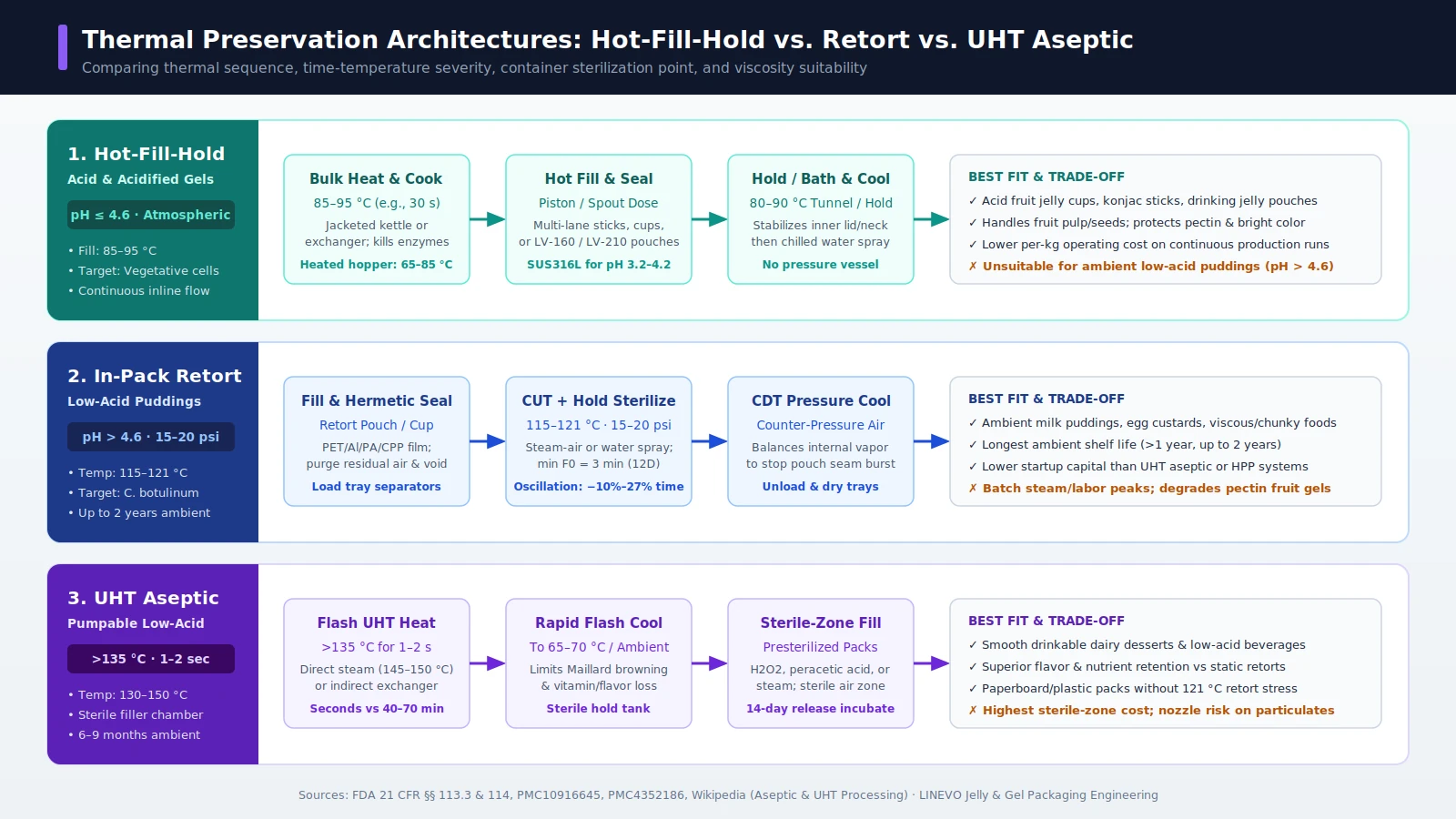
Unlike in-pack retorting, UHT aseptic processing sterilizes bulk liquid food outside the package above 135 °C for 1–2 s (130–150 °C) and fills cooled product into presterilized containers inside a microorganism-free zone under § 113.3. UHT aseptic lines preserve fresher flavor and nutrients than prolonged retorting, but require higher capital investment, stricter sterile-air control, and pumpable viscosity.
The thermal-exposure contrast is dramatic: historical Dole aseptic benchmarks heated liquid soup to 140–146 °C (280–290 °F) for 3.53 s with an 8.8 s hold and 14.0–17.0 s cooling to 32 °C (90 °F), replacing 40–70 min of conventional retorting at 115–121 °C (240–250 °F). In dairy applications, UHT aseptic packaging delivers a typical unrefrigerated shelf life of six to nine months—compared with about two weeks chilled for flash pasteurization and up to 2 years ambient for hermetically sealed retort packs.
| Decision Dimension | Hot-Fill-Hold | Pressurized Overpressure Retort | UHT + Aseptic Packaging |
|---|---|---|---|
| Sterilization Sequence | Bulk heat -> hot fill -> seal -> atmospheric hold/cool | Fill -> hermetic seal -> pressurized vessel heat & cool | Bulk UHT flash heat -> cool -> sterile fill into presterilized pack |
| Temperature & Hold | 85–95 °C (e.g., 90–95 °C for 30 s) | 115–121 °C (240–250 °F), minimum F0 = 3 min | Above 135 °C for 1–2 s (130–150 °C; e.g., 140–146 °C for 3.53 s) |
| Regulatory Scope | Acid / acidified foods (pH 4.6 or below, Part 114) | Low-acid hermetically sealed foods (§ 113.3) | Low-acid or acidified aseptic (§ 113.3, Form 2541c / 2541a) |
| Viscosity & Particulates | High tolerance for fruit gels, pulp, and seeds | High tolerance for viscous puddings, custards, and solids | Best for pumpable low-acid liquids; steam infusion risks nozzle blockage |
| Ambient Shelf Life | Acid-stable ambient distribution | Over a year, up to 2 years ambient | Six to nine months (typical dairy) to longer barrier spans |
| Capital & Validation Complexity | Lowest mechanical and sterile-zone complexity | Moderate batch startup cost; higher steam/labor opex | Highest capital and air-sterility complexity; 14-day release incubation |
For dessert lines, UHT aseptic processing introduces two practical constraints beyond capital cost. First, aseptic packaging costs more than retort canning because packaging materials require separate sterilization machinery and maintaining air sterility inside the filling room is difficult; U.S. filings use Form 2541c for low-acid aseptic foods and Form 2541a for acidified aseptic foods, followed by a 14-day minimum release incubation (20–25 °C for at least 7 days followed by 30–35 °C). Second, direct steam infusion heats to approximately 145 °C before flash cooling to 65–70 °C and handles higher viscosities than steam injection, but still risks nozzle blockage when dosing thick hydrocolloid gels or particulate fruit inclusions. For a deeper microbiological breakdown of pasteurization versus commercial sterilization lethality, review our pasteurization vs. sterilization thermal guide.
Frequently Asked Questions
Can you use hot fill instead of retort for ambient milk pudding cups or pouches?
No. Neutral-pH milk puddings and dairy custards have a finished equilibrium pH above 4.6 and water activity above 0.85, classifying them as low-acid foods under § 113.3. Because atmospheric hot-fill-hold at 85–95 °C does not eliminate Clostridium botulinum spores, ambient-stored low-acid puddings require commercial sterilization—such as pressurized retorting at 115–121 °C achieving at least F0 = 3 min or UHT aseptic processing.
Why should acidic fruit jellies avoid 121 °C retort sterilization?
Acidic fruit jellies formulated at pH 3.2–4.2 sit safely below the pH 4.6 threshold that prevents Clostridium botulinum spore growth. Exposing pectin-based fruit gels to 121 °C pressurized retorting for 4 to 20 min accelerates pectin decomposition, water syneresis, and color darkening without adding food-safety benefit over hot-fill-hold up to 85 °C and 80–90 °C atmospheric water-bath pasteurization.
What happens if standard hot-fill film is placed inside a retort autoclave?
Standard hot-fill films using LLDPE sealants or easy-peel lidding lacquers are engineered for atmospheric temperatures up to 85–90 °C rather than 116–121 °C pressurized steam. Without FDA-approved three-layer PET/Al/CPP or four-layer PET/Al/PA/CPP retort laminates, crate separators, and counter-pressure air cooling during come-down time, internal vapor expansion causes pouch distortion, seal failure, or bursting.
Which retort heating mode works best for flexible jelly and pudding pouches?
Horizontal steam-air retorts and pressurized water-spray or water-immersion retorts work best for flexible pouches and semi-rigid cups because they provide independent control of temperature and overpressure air during both heating and cooling. Pure saturated steam retorts experience pressure fluctuations that increase pouch distortion and cold-spot risk.
How does shelf life compare across hot fill, retort, and UHT aseptic packaging?
Pressurized retort sterilization delivers the longest ambient shelf life—over a year and up to 2 years in hermetically sealed pouches or containers. UHT aseptic packaging has a typical unrefrigerated shelf life of six to nine months for dairy liquids with fresher flavor retention, while hot-fill-hold delivers ambient stability strictly for acid and acidified formulations held at equilibrium pH 4.6 or below.
Sources
- Food Science & Nutrition / PubMed Central: Understanding Retort Processing
- U.S. Electronic Code of Federal Regulations (eCFR): FDA Thermally Processed Low-Acid Foods Packaged in Hermetically Sealed Containers (Definitions)
- U.S. Electronic Code of Federal Regulations (eCFR): FDA Acidified Foods Regulation
- PubMed Central: Development of Food Packaging Materials
- Advances in Nutrition / PubMed Central: Squeezing Fact from Fiction about Fruit Juice
- PubMed Central: Alicyclobacillus Ecology and Preserving Food Quality
- PubMed Central: Effect of Heating Methods on Syneresis and Physical Properties of Persimmon Paste
- Wikipedia: Retort Pouch
- Wikipedia: Aseptic Processing
- Wikipedia: Ultra-High-Temperature Processing
Related Specifications
Formulation-Matched Setups: Konjac, Collagen, Particulate Gels & Gummies
Match konjac snacks, collagen sticks, marathon energy gels, fruit-inclusion jellies, and pectin gummies to verified LINEVO dosing pumps, weighers, and sealers.
Learn moreSizing Lane Counts, Budget Tiers & Leak-Test FAT for Jelly Lines
Engineering buyer hub for calculating multi-lane stick and cup output, sizing parent film reels, comparing LINEVO equipment budgets, and running hot-fill FAT.
Learn moreFurther Engineering Reference
Hot-Fill Jelly Dosing Pumps, CIP Hoppers & Barrier Laminate Specifications
Engineering specification guide for jacketed heated hoppers, rotary-valve piston dosing, anti-drip nozzles, SUS316L CIP manifolds, and retort/hot-fill jelly films.
Learn moreAutomatic Jelly Cup Fill-Seal, Spout Pouch & Premade Stand-Up Pouch Machines
Compare LINEVO SUS304/316L CIP jelly cup filling-sealing machines, LV-160 spout pouch fillers, and LV-210 high-speed premade stand-up and zipper pouch lines.
Learn moreLV-160 Spouted Drinking-Jelly Fillers & LV-210 Stand-Up Multipack Baggers
Specifications for LINEVO LV-160 spout pouch liquid/gel fillers (10–15 bags/min) and LV-210 stand-up beverage and zipper multipack lines (20–70 bags/min).
Learn moreStick Pack vs 4-Side Sachet vs Cup Sealer vs Spout Pouch Decision Matrix
Step-by-step engineering guide comparing multi-lane stick packs, 4-side sachets, CIP cup sealers, LV-160 spout pouches, and LV-210 / VFFS gummy baggers.
Learn morePasteurization vs. Sterilization: Jelly, Jam & Pudding Thermal Guide
Compare pasteurization vs sterilization temperatures, spore kill, pH 4.6 rules, and gel texture retention to pick the right thermal route for jellies and puddings.
Learn more