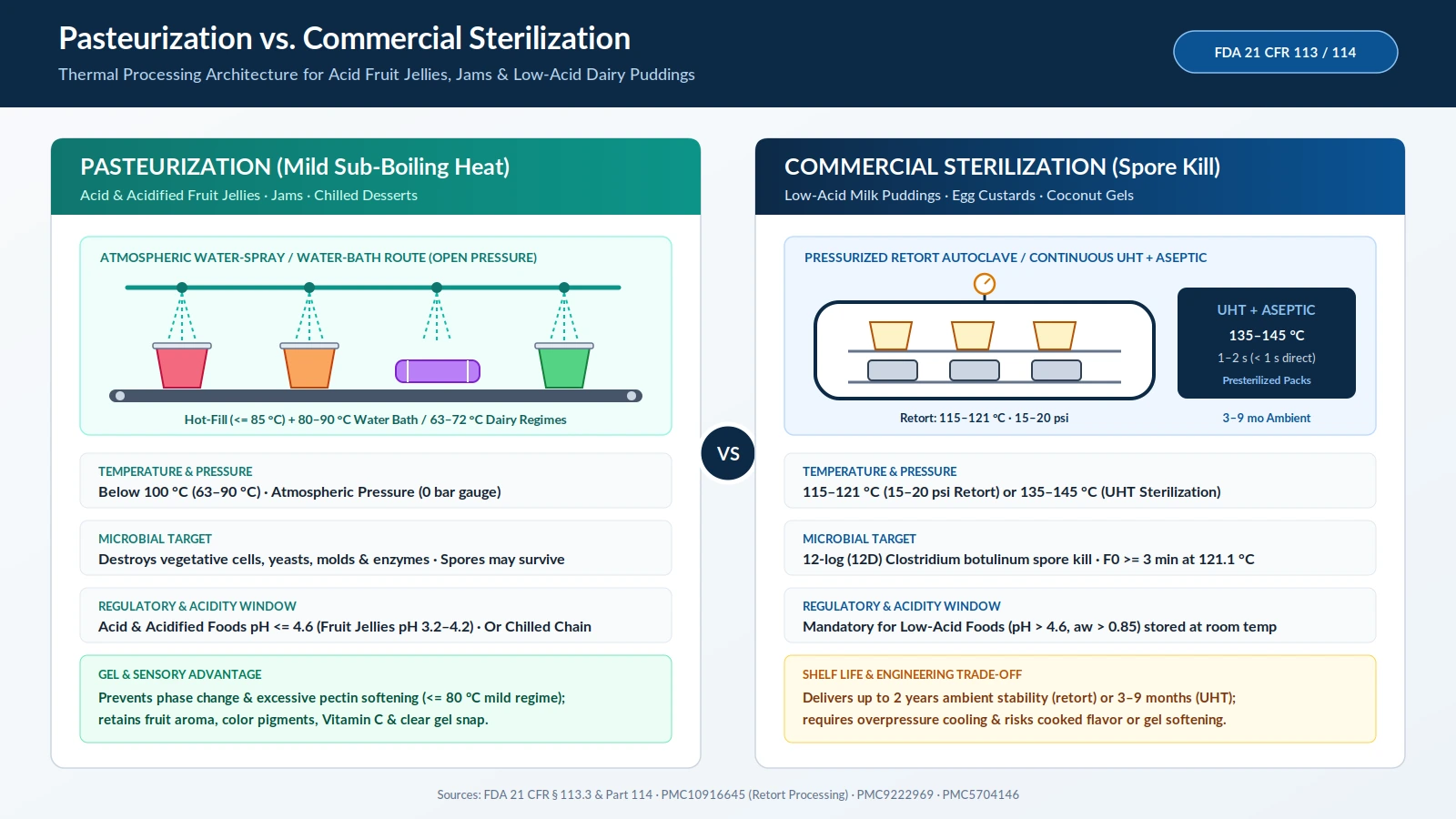
Pasteurization applies mild sub-boiling heat below 100 °C to eliminate vegetative pathogens, yeasts, molds, and spoilage enzymes while leaving bacterial spores potentially viable. Commercial sterilization uses pressurized heat at 115–121 °C or ultra-high temperatures at 135–145 °C to destroy Clostridium botulinum spores for ambient stability, dividing acid fruit jellies (pH 4.6 or below) from low-acid milk puddings.
Are Pasteurization and Sterilization the Same in Food Packaging?
No—pasteurization and sterilization serve distinct microbiological objectives in commercial food packaging. Pasteurization delivers controlled sub-boiling thermal treatment that eliminates vegetative pathogens and spoilage organisms while leaving heat-resistant bacterial spores viable, whereas commercial sterilization eliminates viable spores of public-health significance so hermetically sealed containers remain safe during nonrefrigerated storage and distribution.
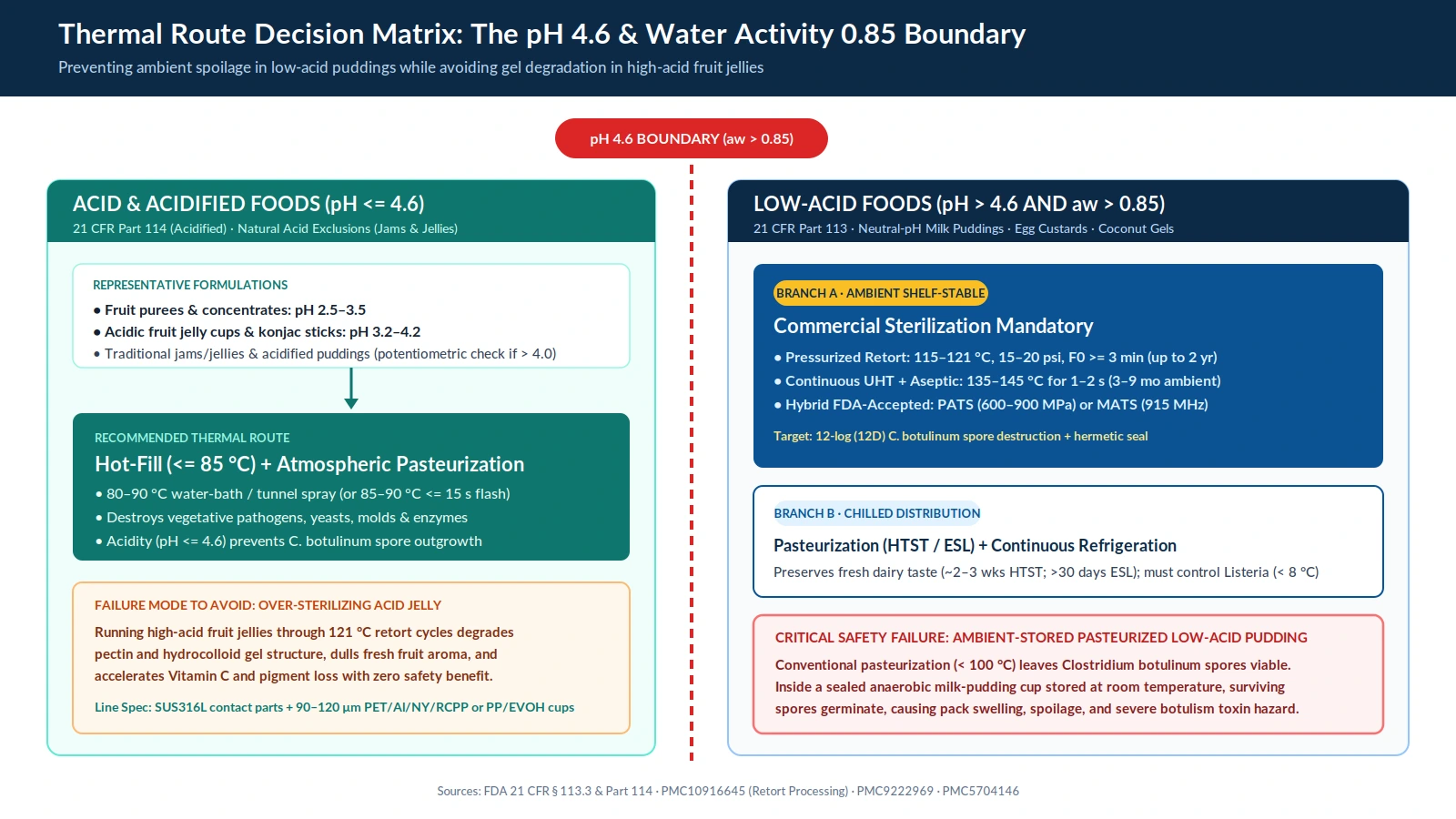
Choosing the wrong thermal route on a dessert packaging line triggers one of two operational failures. Applying atmospheric pasteurization alone to a neutral-pH milk pudding or egg custard intended for ambient retail leaves anaerobic bacterial spores viable inside the hermetically sealed cup, risking gas swelling, spoilage, and botulinum toxin formation. Conversely, pushing an acid fruit jelly at pH 3.2–4.2 through a pressurized retort subjects hydrocolloid gel networks, fruit aromatics, and Vitamin C to excessive heat without gaining additional food-safety protection.
| Engineering Dimension | Pasteurization | Commercial Sterilization |
|---|---|---|
| Primary Microbial Target | Vegetative pathogens, yeasts, molds, and spoilage enzymes | All viable public-health and spoilage organisms, including bacterial spores |
| Typical Temperature Window | Below 100 °C (63–90 °C atmospheric or heat-exchanger regimes) | 115–121 °C pressurized retort or 135–145 °C continuous UHT |
| Operating Pressure | Atmospheric pressure in baths, tunnels, or heat exchangers | Pressurized closed retort (15–20 psi) or pressurized UHT holding tube |
| Regulatory Food Fit | Acid and acidified foods at pH 4.6 or below, or chilled low-acid foods | Low-acid foods above pH 4.6 with water activity above 0.85 for ambient storage |
| Resulting Shelf Life | Two to three weeks chilled (HTST) or ambient acid-stable fruit packs | Up to 2 years ambient (retort) or three to 9 months ambient (UHT aseptic) |
| Sensory and Gel Impact | Preserves pectin firmness, pigments, fruit aroma, and gel elasticity | Higher risk of cooked flavor, nutrient loss, and thermal gel softening |
How Do Pasteurization vs. Sterilization Temperatures and Hold Times Differ?
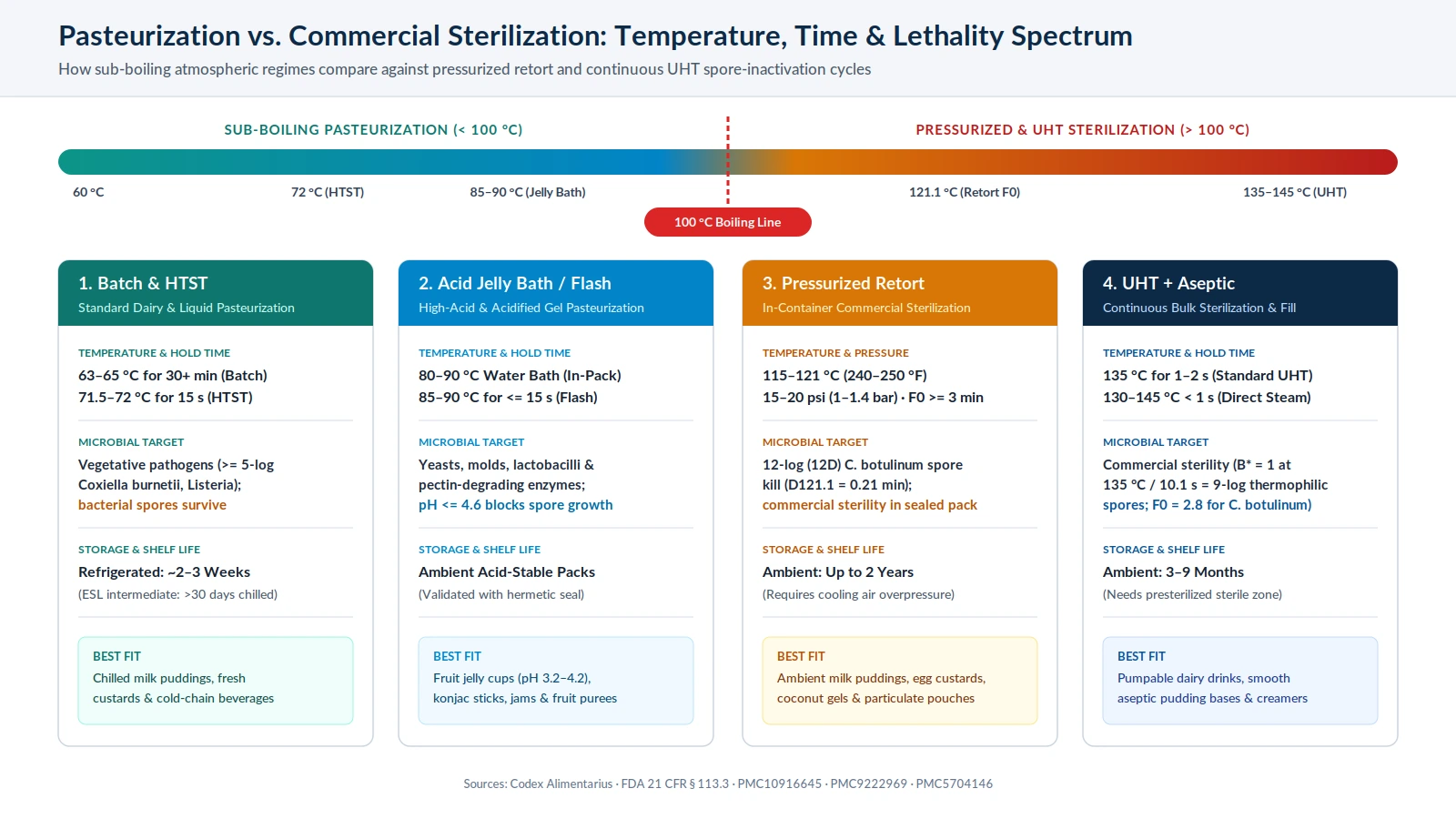
Pasteurization temperatures stay below 100 °C (212 °F), spanning batch holds at 63–65 °C for over 30 min, continuous HTST at 71.5–72 °C for 15 s, and acid-jelly water baths at 80–90 °C. Commercial sterilization crosses above boiling, operating at 115–121 °C under 15–20 psi in closed retorts or 135–145 °C for seconds in continuous UHT systems.
Between standard HTST pasteurization and full UHT sterilization sits extended shelf-life (ESL) or ultra-pasteurized processing, which applies intermediate thermal severity to extend refrigerated dairy shelf life beyond 30 days. Across every regime, food engineers trade higher temperature against exponentially shorter holding time to balance microbial inactivation against thermal degradation of flavor and texture.
| Thermal Processing Regime | Temperature Setpoint | Holding Duration | Pressure / Packaging Mode | Target Shelf Life |
|---|---|---|---|---|
| Slow Batch Pasteurization | 63–65 °C (145 °F min) or 75 °C | Over 30 min (or 8–10 min at 75 °C) | Atmospheric batch vessel | Chilled distribution |
| Continuous HTST Pasteurization | 71.5–72 °C (160.7–162 °F) | 15 s | Turbulent heat exchanger + chilled fill | Approximately two weeks refrigerated |
| Acid Jelly Water-Bath / Flash | 80–90 °C bath or 85–90 °C flash | In-pack hold or up to 15 s flash | Atmospheric tunnel after up to 85 °C hot fill | Ambient acid-stable (pH 4.6 or below) |
| Extended Shelf-Life (ESL) | Between HTST and UHT | Short high-temp hold | Direct or indirect exchanger + hygienic fill | More than 30 days refrigerated |
| Pressurized Retort Sterilization | 115–121 °C (240–250 °F) | Scheduled hold to reach F0 of 3 min or higher | Closed retort at 15–20 psi (1–1.4 bar) | Up to 2 years at room temperature |
| UHT Sterilization + Aseptic | 135 °C (275 °F) or 130–145 °C direct | 1–2 s (or under 1 s in direct steam infusion) | Sterilized bulk cooled into presterilized packs | Three to 9 months at room temperature |
How D-Value, Z-Value, F0, and B* Quantify Thermal Lethality
Thermal death of bacteria follows first-order semilogarithmic kinetics, which means absolute sterility across every container is mathematically unattainable and industrial lines instead design for commercial sterility. Engineers quantify microbial heat resistance using the D-value—the heating duration at a constant temperature needed to kill 90% (1 log) of a target population—and the Z-value, which is the temperature shift required to change the D-value by 1 log unit.
For low-acid pressurized retorts, cumulative lethality is tracked through the F0 value referenced to 121.1 °C (250 °F). Using a benchmark D121.1 value of 0.21 min for Clostridium botulinum spores, a 12-log (12D) reduction equals 2.52 min; since 1965, food processors have applied a minimum botulinum cook of F0 = 3 min for low-acid shelf-stable items. In continuous UHT lines, lethality is additionally benchmarked using B*, where B* = 1 equals holding product at 135 °C for 10.1 s to deliver a 9-log reduction of thermophilic spores, while F0 = 2.8 achieves a 12-log reduction of Clostridium botulinum spores equivalent to 121.1 °C for 2.8 min.
What Is the Key Microbial Difference Between Pasteurization and Sterilization?
The decisive microbial difference is spore inactivation: pasteurization kills vegetative pathogens and spoilage flora such as Listeria monocytogenes, Coxiella burnetii, yeasts, molds, and lactobacilli, whereas commercial sterilization destroys heat-resistant bacterial spores—most critically anaerobic Clostridium botulinum—that survive boiling and germinate inside hermetically sealed low-acid packages.
Codex Alimentarius minimum milk pasteurization standards (72 °C for 15 s continuous or 63 °C for 30 min batch) are engineered to achieve at least a 5-log reduction of Coxiella burnetii while destroying vegetative pathogens and common yeasts and molds. Controlling vegetative cells remains critical even on refrigerated pudding lines because Listeria monocytogenes can survive and multiply at cold-chain temperatures below 8 °C. In acidic fruit products at pH 4.6 or below, low pH already prevents most bacterial pathogens from growing, so pasteurization specifically targets spoilage yeasts, lactobacilli, and quality-degrading enzymes such as pectin methylesterase and polygalacturonase.
Commercial sterilization targets far tougher spore-forming bacteria, including Clostridium botulinum, Bacillus species, and Clostridium thermosaccharolyticum, which tolerate sub-boiling heat and thrive under the anaerobic conditions inside hermetically sealed cups and foil pouches. Because handling toxic Clostridium botulinum strains in production validation is hazardous, thermal process authorities commonly validate 12D sterilization cycles using non-toxic Clostridium sporogenes spores, whose reported D-value at 121 °C reaches 0.5 min in pH 7.0 phosphate buffer.
How Is Commercial Pasteurization Different From Simple Boiling?
Simple boiling heats aqueous foods to 100 °C (212 °F) at atmospheric pressure and triggers a liquid-to-vapor phase change that drives moisture evaporation, pectin breakdown, and volatile aroma loss. Commercial pasteurization holds food strictly below 100 °C for a validated time followed by controlled cooling specifically to prevent phase change while achieving targeted vegetative lethality.
For fruit jellies, jams, and functional gel sticks, avoiding unnecessary boiling or over-retorting directly protects mouthfeel, color, and active nutrition. Severe thermal processing causes significant losses in heat-labile nutrients such as Vitamin C and carotene, whereas mild pasteurization preserves plant pigments and limits enzymatic and non-enzymatic pectin breakdown—with mild treatments at or below 80 °C (176 °F) avoiding pectin-driven tissue softening.
Protecting Gel Elasticity, Pectin Structure, and Flavor Across Thermal Routes
When a formulation requires full commercial sterilization—such as an ambient neutral-pH milk pudding or coconut custard—heat-transfer speed governs how much texture and flavor survive the cycle. In static retorts where containers sit stationary, slow heat penetration creates internal temperature zones that cause overcooking near package walls alongside uneven texture and cooked off-flavor. Excessive microbiological safety margins compound that nutrient loss and sensory dulling.
Two industrial engineering upgrades cut thermal abuse during sterilization without sacrificing spore lethality. First, introducing oscillating retort motion has been shown to reduce calculated thermal process time by 10%–27% compared with static retorting at identical temperature parameters. Second, in continuous UHT and ESL liquid processing, direct steam injection or steam infusion heats and cools far faster than indirect heat exchangers, generating noticeably less chemical change and cooked flavor for the exact same spore-inactivation target.
When Is Pasteurization Effective Enough for Fruit Jellies, Jams, and Puddings?
Pasteurization is sufficient for ambient shelf stability whenever product acidity sits at a finished equilibrium pH of 4.6 or below or water activity stays at 0.85 or below, because Clostridium botulinum spores cannot germinate and produce toxin under those hurdles. Once equilibrium pH exceeds 4.6 and water activity exceeds 0.85, ambient storage requires commercial sterilization.
Under FDA low-acid food definitions in § 113.3, low-acid foods are foods other than alcoholic beverages with a finished equilibrium pH greater than 4.6 and water activity greater than 0.85 (excluding tomato products below pH 4.7). Under federal acidified-food rules, natural acid foods have a pH of 4.6 or below—covering most fruit purees and concentrates at pH 2.5–3.5—while acidified foods are low-acid bases adjusted with acid to achieve water activity above 0.85 and finished equilibrium pH of 4.6 or below, a category that explicitly includes acidified puddings. Traditional jams, jellies, preserves, carbonated beverages, and refrigerated foods are excluded from acidified-food part coverage, whereas acidified dessert cups formulated from low-acid bases must comply with § 114.80 and § 114.83 scheduled-process controls.
| Dessert Product Family | Typical Equilibrium pH & Water Activity | Required Thermal Route | Key Regulatory & Quality Control Checkpoint |
|---|---|---|---|
| Fruit purees & concentrates | pH 2.5–3.5 (natural acid food) | Pasteurization (flash or in-pack water bath) | Target yeasts, molds, lactobacilli, and pectin enzymes |
| Acidic fruit jelly cups & konjac sticks | pH 3.2–4.2 with citric or malic acid | Hot-fill up to 85 °C + 80–90 °C water-bath pasteurization | Verify seal integrity and avoid over-heating gel network |
| Acidified puddings & low-acid bases with added acid | pH 4.6 or below, water activity above 0.85 | Validated thermal pasteurization destroying vegetative cells | Potentiometric equilibrium pH testing mandatory if pH exceeds 4.0 |
| Ambient neutral-pH milk puddings, egg custards & coconut gels | pH above 4.6, water activity above 0.85 | Commercial sterilization (retort or UHT + aseptic) | Minimum F0 of 3 min at 121.1 °C and hermetic seal validation |
| Chilled dairy puddings & fresh custards | pH above 4.6, water activity above 0.85 | HTST or ESL pasteurization + continuous cold chain | Prevent Listeria monocytogenes growth below 8 °C and control post-fill hygiene |
Federal Acidified-Food Rules and Line Integration for Jelly and Pudding Packs
Whenever an acidified gel or pudding operates with a finished equilibrium pH above 4.0, federal controls under § 114.80 require verifying final equilibrium pH using a potentiometric method rather than relying solely on titration or colorimetry; products at pH 4.0 or below may use any suitable acidity method. Processors manufacturing regulated acidified foods must establish scheduled processes through a qualified authority under § 114.83 and handle process deviations under § 114.89.
Upstream dosing, metallurgy, and packaging film choices must match the chosen thermal route on turnkey jelly cooking and packing lines. Acidic fruit jellies running at pH 3.2–4.2 with citric or malic acid specify SUS316L stainless steel wetted contact parts paired with food-grade PTFE or EPDM seals to resist acid corrosion across washdown shifts. Hydrocolloid formulations such as konjac-xanthan and kappa-carrageenan require tightly heated hoppers and insulated manifolds because an 8 °C temperature drop can shift a pumpable 600 cP fluid into a semi-solid plug and push lane weight variance past ±5%.
For packaging containment, konjac and collagen stick packs rely on 90–120 micron PET/Al-Foil/NY/RCPP or LLDPE laminates rated for hot-fill contact up to 85 °C and 80–90 °C atmospheric water-bath pasteurization—covered in our hot-fill jelly dosing and film specifications. For sealed cups and pouches moving straight into atmospheric water-spray holding and cooling, review spray-zone controls in our tunnel pasteurizer guide, match recipe rheology in konjac, fruit, and supplement setups, or compare cup sealers and spout fillers on jelly cup and pouch machines.
What Are the Main Commercial Sterilization Methods Used in Food Lines?
Commercial food lines achieve commercial sterility through four primary industrial pathways: pressurized moist-heat retorts, continuous UHT thermal sterilization paired with aseptic packaging, atmospheric flame sterilizers for agitated rigid cans, and FDA-accepted hybrid sterilization systems—pressure-assisted thermal sterilization (PATS) and microwave-assisted thermal sterilization (MATS).
Pressurized retorts remain the workhorse for hermetically sealed low-acid pudding cups, retort pouches, jars, and cans. Industrial retorts operate in three main heating modes—saturated steam, falling water (water spray or cascade), and full water immersion—including steam-air mixtures designed for flexible pouches and semi-rigid cups. Because rapid cooling after a 115–121 °C hold can cause internal vapor pressure to burst flexible pouches or deform semi-rigid cups, retort lines inject counter-balancing overpressure air throughout the come-down cooling stage to maintain package integrity.
Continuous UHT sterilization heats pumpable low-acid dairy and dessert bases to 135 °C for 1–2 s (or 130–145 °C for under 1 s in direct steam infusion) before cooling and filling into presterilized containers inside a microorganism-free atmosphere under § 113.3 aseptic rules. Equipment and containers achieve commercial sterility through heat, chemical sterilants, or equivalent treatments, delivering three to 9 months of ambient stability with fresher flavor than static retorting—though thick fruit-inclusion jellies and viscous particulate gels cannot easily flow through narrow aseptic exchangers.
| Commercial Sterilization Method | Operating Principle & Conditions | Package Compatibility | Key Advantage & Practical Trade-Off |
|---|---|---|---|
| Pressurized Retort (Steam, Water Spray, Immersion, Steam-Air) | Closed vessel at 115–121 °C (15–20 psi), F0 of 3 min or higher, with overpressure air cooling | Hermetically sealed retort pouches, PP/EVOH cups, cans, glass jars | Handles viscous puddings and particulates for up to 2 years ambient; higher cumulative heat load |
| UHT + Aseptic Packaging | 135 °C for 1–2 s (or 130–145 °C under 1 s direct) filled cold into presterilized packs | Presterilized cartons, aseptic cups, and sterile pouches | Shorter heat exposure preserves flavor for three to 9 months ambient; requires sterile zone and pumpable viscosity |
| Flame Sterilizer | Agitated hermetically sealed containers exposed to impinging gas flames at atmospheric pressure | Rigid metal cans tolerating direct flame agitation | Fast heat transfer in agitated cans; unsuitable for polymer cups or flexible jelly pouches |
| Hybrid PATS / MATS (FDA-Accepted) | PATS: 600–900 MPa + 90–121 °C; MATS: 915 MHz microwave + 121 °C hot-water convection | Polymeric pouches and trays for low-acid foods (pH above 4.6) | Cuts come-up time and retains more heat-sensitive nutrients; higher instrumentation complexity |
For processors evaluating whether a recipe fits an atmospheric water-spray pasteurizer or requires a pressurized sterilization workflow, share your target equilibrium pH, container format, fill temperature, and hourly output with LINEVO engineers via WhatsApp to request our high-acid jelly and low-acid pudding thermal route checklist.
Frequently Asked Questions
Are pasteurization and sterilization the same thing for packaged desserts?
No. Pasteurization uses mild sub-boiling heat below 100 °C to destroy vegetative pathogens, yeasts, and molds while leaving heat-resistant bacterial spores potentially viable. Commercial sterilization applies pressurized heat (115–121 °C retort) or UHT processing (135–145 °C) to destroy bacterial spores such as Clostridium botulinum for long-term nonrefrigerated storage.
Can you store pasteurized milk pudding at room temperature without refrigeration?
No—neutral-pH milk puddings, egg custards, and coconut gels have a finished equilibrium pH above 4.6 and water activity above 0.85, classifying them as low-acid foods. Because conventional pasteurization leaves Clostridium botulinum spores viable, ambient-stored low-acid puddings rely on commercial sterilization achieving at least F0 = 3 min at 121.1 °C (or UHT plus aseptic packaging), whereas pasteurized low-acid puddings rely on continuous refrigeration.
Why is pasteurization preferred over retort sterilization for acid fruit jellies and jams?
Acid fruit purees (pH 2.5–3.5) and acidic fruit jellies (pH 3.2–4.2) sit at or below the pH 4.6 threshold that prevents Clostridium botulinum spore germination. Running those packs through 121 °C pressurized retorts degrades pectin and gel texture, dulls fresh fruit aroma, and accelerates Vitamin C loss without improving food safety over hot-fill (up to 85 °C) and 80–90 °C atmospheric pasteurization.
How is commercial pasteurization different from boiling food at 100 °C?
Boiling heats liquids to 100 °C (212 °F) and causes a phase change that evaporates moisture, softens pectin structure, and strips volatile flavors. Commercial pasteurization holds food strictly below 100 °C—such as 63–65 °C for 30 min, 72 °C for 15 s, or 80–90 °C for acid jellies—followed by rapid cooling to inhibit phase change and preserve sensory quality.
What pH testing rule applies to acidified puddings and gel cups?
Under federal acidified-food controls in § 114.80, any regulated acidified product whose finished equilibrium pH exceeds 4.0 must have its final equilibrium pH verified using a potentiometric method, and in-process titration or colorimetric checks must be correlated to that equilibrium reading. Products at pH 4.0 or below may use any suitable acidity measurement method.
Sources
- U.S. Electronic Code of Federal Regulations (eCFR): FDA Thermally Processed Low-Acid Foods Packaged in Hermetically Sealed Containers (Definitions)
- U.S. Electronic Code of Federal Regulations (eCFR): FDA Acidified Foods Regulation
- Food Science & Nutrition / PubMed Central: Advancements in Retort Processing
- Foods / PubMed Central: Effect of Hurdle Approaches Using Conventional and Moderate Thermal Processing Technologies for Microbial Inactivation in Fruit and Vegetable Products
- Foods / PubMed Central: Optimum Thermal Processing for Extended Shelf-Life (ESL) Milk
- Wikipedia: Pasteurization
Compatible Downstream Line Equipment
Related Specifications
Further Engineering Reference
Hot-Fill Jelly Dosing Pumps, CIP Hoppers & Barrier Laminate Specifications
Engineering specification guide for jacketed heated hoppers, rotary-valve piston dosing, anti-drip nozzles, SUS316L CIP manifolds, and retort/hot-fill jelly films.
Learn moreAutomatic Jelly Cup Fill-Seal, Spout Pouch & Premade Stand-Up Pouch Machines
Compare LINEVO SUS304/316L CIP jelly cup filling-sealing machines, LV-160 spout pouch fillers, and LV-210 high-speed premade stand-up and zipper pouch lines.
Learn moreFormulation-Matched Setups: Konjac, Collagen, Particulate Gels & Gummies
Match konjac snacks, collagen sticks, marathon energy gels, fruit-inclusion jellies, and pectin gummies to verified LINEVO dosing pumps, weighers, and sealers.
Learn moreTurnkey Primary Jelly Filling, Secondary Multipack Weighing & Cartoning Lines
Configure turnkey LINEVO jelly lines from multi-lane stick or CIP cup fillers through cooling and drying to LV-210 zipper multipack baggers and cartoners.
Learn moreTunnel Pasteurizer: Zones, Hold Time & Cup Line Integration
A tunnel pasteurizer heats, holds, and cools sealed jelly cups, pouches, and jars across three water-spray zones to stop post-fill recontamination.
Learn more