Two-Stage Particulate Fruit Cups & Solidifying Paste/Petroleum Jellies
Pumping whole mandarin orange segments or 8 mm chewy nata-de-coco cubes mixed inside hot carrageenan syrup through a single piston crushes fruit and jams check valves—resulting in one cup with 8 cubes and the next cup with zero! Within jelly product setups and hot-fill jelly dosing and film specs, industrial fruit-cup lines split dosing into two dedicated stations: a gentle rotary-pocket or multihead solid filler first, followed by heated liquid syrup top-off.
Meanwhile, non-aqueous petroleum jelly (Vaseline), lip balms, pomades, and thick pectin jams use jacketed 55–75 °C gear/piston jar fillers (LD-ALF tracking/inline class, 50–1,000 ml, 15–60 jars/min) followed by ambient/chilled cooling conveyors before capping so jar surfaces solidify mirror-smooth without lid condensation!

Two-Stage Fruit Cup vs Hot-Melt Petroleum Jelly Jar Line
Compare hardware setups across dual-phase dessert cups and solidifying paste jars:
| Line Parameter | Nata-de-Coco / Fruit Jelly Cup Line | Petroleum Jelly / Wax / Jam Jar Line |
|---|---|---|
| Dosing Sequence | Station A: Solid cubes -> Station B: 80 °C sol | Heated jacketed tank (60 °C) -> heated gear/piston |
| Container Type | 55–95 mm wide PP/EVOH barrier cups | 50–1,000 ml wide-mouth PP/PET/glass jars |
| Post-Fill Thermal Step | Seal first -> 85 °C pasteurize -> chill bath | Cool open/hooded jar on chilled belt FIRST -> then cap! |
| Output Range | 2,400 – 9,000+ cups/hr | 15 – 80 jars/min (1-to-8 heated heads) |
Explore cup sealer platforms in rotary and linear jelly cup machines.
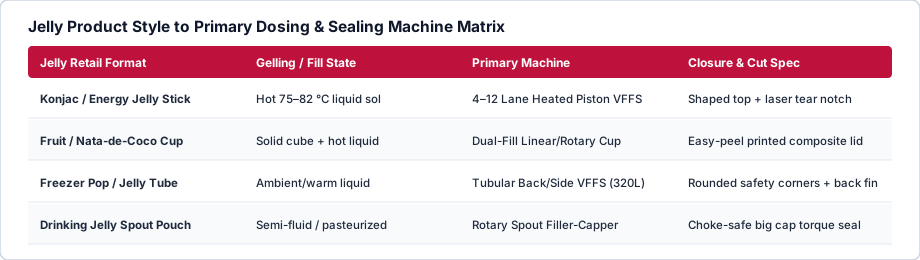
Hot-Fill Jelly Engineering Notes
- Why Petroleum Jelly Cools BEFORE Capping: Capping
62 °Cmelted petroleum jelly immediately traps warm vapor that condenses droplets onto the lid and shrinks a deep crater in the center; a laminar filtered cooling tunnel sets a flat glossy top before capping. - Heated Double-Jacketed Hoses & Nozzles: Petroleum jelly congeals below
45 °C—all pump heads, hoses, and nozzles must be water-jacketed or electrically heat-traced. - Multihead Combination Weigher for Whole Mandarin/Peach Cups: For irregular fruit segments (mandarin, peach dices, aloe vera), mount a waterproof 10/14-head weigher directly above the linear cup machine’s pockets.
Specify Your Fruit Inclusion or Paste Jar Line
Describe your solid piece size or melting point via Project Brief.
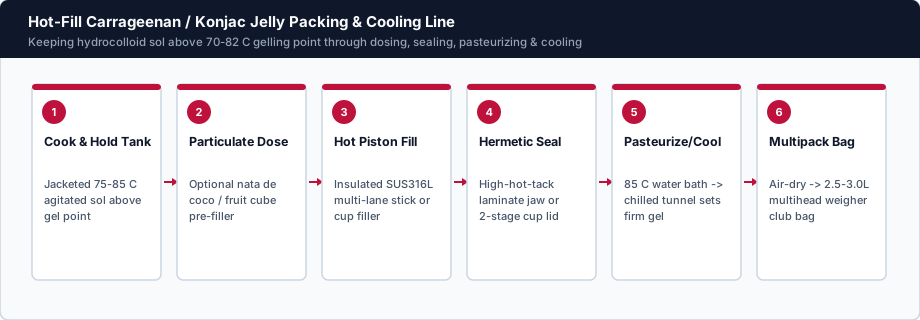
Explore related equipment in Jelly Packing Machines, Hot-Fill Dosing & Film Specs, or send your stick/cup dimensions via Project Brief.