A tunnel pasteurizer is a continuous in-package thermal processing machine that conveys sealed jelly cups, flexible pouches, sticks, and glass jars through three water-spray zones—preheating, pasteurization holding, and staged cooling. Treating the product, container wall, and lid or cap together prevents post-fill recontamination while limiting abrupt headspace pressure surges and thermal shock.
How Does a Commercial Tunnel Pasteurizer Work?
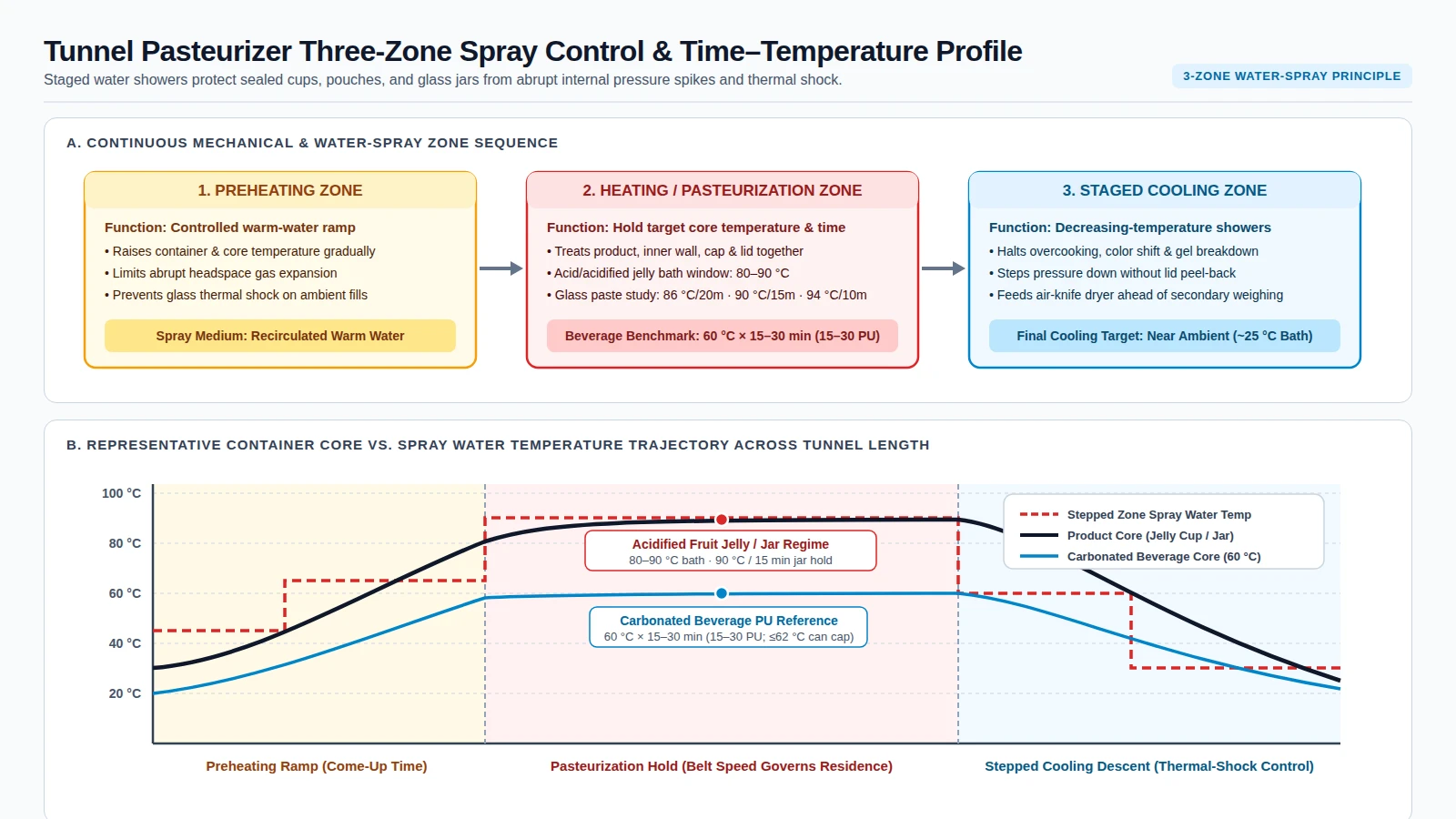
A commercial tunnel pasteurizer moves already filled and hermetically sealed containers along a continuous mesh belt beneath overhead water-spray headers split into three thermal zones: a preheating zone, a heating or pasteurization zone, and a cooling zone. Controlled water showers raise core temperature, hold lethality for the scheduled duration, and step temperature back down without abrupt pressure changes.
Because the thermal treatment acts simultaneously on the packaged food, inner container wall, and lid or cap, in-package tunnel pasteurization eliminates post-filling recontamination risks that arise when product is heat-treated upstream of an open filler. On turnkey jelly cooking and packing lines, sealed cups and stick packs discharge from primary sealers directly onto stainless mesh conveyors feeding atmospheric pasteurization and chilled-water cooling sections.
| Tunnel Zone | Primary Thermal Role | Water-Spray Medium | Container Protection Mechanism |
|---|---|---|---|
| Preheating zone | Raises sealed container and product core temperature progressively | Warm recirculated water spray | Prevents abrupt headspace gas expansion and reduces thermal shock on glass walls |
| Heating / pasteurization zone | Holds product core, container wall, and lid at target pasteurization temperature | Temperature-controlled hot-water showers | Eliminates pathogens and spoilage microorganisms across both food and closure surfaces |
| Staged cooling zone | Lowers product temperature back toward handling and packing ambient | Decreasing-temperature and chilled-water showers | Halts overcooking and color loss while stepping internal pressure down gently |
How Are Tunnel Pasteurization Temperatures and Hold Times Controlled?
Zone temperatures are maintained independently by recirculated water-spray circuits while conveyor belt speed determines total residence time inside the holding section. Depending on product acidity, container material, and viscosity, commercial tunnel regimes span 60 °C for 15–30 min in carbonated beverages up to 80–90 °C atmospheric baths for fruit jelly packs and 86–94 °C for 10–20 min in glass-packed food pastes.
Pasteurization Units Versus Acidified Food Hold Cycles
In carbonated beverage tunnels, thermal lethality is tracked in pasteurization units (PU), a combined measure of process temperature and holding time. Typical commercial beer lines target 15 to 30 PU, corresponding to a pasteurization temperature of 60 °C maintained for 15–30 min. Theoretically, canned beer should not be pasteurized above 62 °C and target PU values stay between 18–20 so headspace gas expansion remains within container pressure limits.
Semi-solid fruit jellies, fruit purees, and jarred food pastes heat more slowly than thin carbonated liquids and tolerate higher atmospheric bath temperatures. Acidified fruit jelly packaging films and cups are engineered for hot filling up to 85 °C followed by 80–90 °C atmospheric water-bath pasteurization. In industrial tunnel trials on glass-packed olive paste comparing 86 °C for 20 min, 90 °C for 15 min, and 94 °C for 10 min, pasteurizing at 90 °C for 15 min achieved the strongest balance of microbial stability and nutrient retention, preserving 95% of total phenols and delivering 32.9% higher antioxidant activity in reinforced formulations.
| Food Category | Typical Package Format | Holding Temperature & Duration | Primary Control Metric |
|---|---|---|---|
| Carbonated beverages (beer) | Aluminum cans or glass bottles | 60 °C maintained for 15–30 min | 15 to 30 PU lethality target |
| Acidified fruit jelly cups & sticks | PP/EVOH cups or PET/NY/RCPP sticks | 80–90 °C atmospheric water bath after up to 85 °C hot fill | Core thermal hold plus flat easy-peel lid integrity |
| Semi-solid fruit or olive pastes | Glass jars with twist-off metal caps | 86 °C for 20 min, 90 °C for 15 min, or 94 °C for 10 min | Hygienic stability with phenolic and sensory retention |
| High-acid fruit juices & purees | Glass bottles or sealed pouches | pH 2.5–3.5 recipes tailored to viscosity and pack depth | Destruction of vegetative spoilage flora and yeasts/molds |
Cold-Spot Convection and Container Geometry
Computational fluid dynamics (CFD) heat-transfer studies across 330 mL, 500 mL, and 1000 mL sealed juice containers immersed in 60 °C, 80 °C, and 25 °C water baths confirm that natural convection consistently places the slowest-heating cold spot near the bottom of the container and the hot spot near the top. Because lethality validation must verify the coldest point inside the coldest container, probe placement belongs near the lower interior zone rather than near the lid.
Container geometry directly alters come-up time and belt length. Shorter containers promote stronger internal fluid circulation and faster thermal distribution, whereas taller upright containers impede natural convection unless laid horizontally to encourage circular flow. Raising the heating water bath temperature from 60 to 80 °C shortens container come-up times by 12–15%, directly reducing required preheating length when packaging resin and sensory stability permit the higher spray setpoint.
Flash Pasteurization vs. Tunnel Pasteurization: When Does Each Fit?
Flash pasteurization heats bulk liquid in a heat exchanger for seconds before aseptic filling into presterilized containers, whereas tunnel pasteurization treats the sealed package after filling to eliminate post-fill recontamination. Choose flash pasteurization for pumpable, heat-sensitive liquids running on an aseptic filler, and choose a tunnel pasteurizer for viscous jellies, particulate cups, or non-aseptic packaging rooms.
Under federal aseptic processing rules, pre-package sterilization or flash pasteurization demands filling the cooled product into presterilized containers and hermetically sealing them with presterilized closures inside a microorganism-free atmosphere. Rapid heat-exchanger regimes—such as 85 to 90 °C for up to 15 s compared with slow holds of 63 to 65 °C for over 30 min or 75 °C for 8 to 10 min—preserve delicate aroma and color because cumulative heating time stays short. However, thick hydrocolloid gels and fruit-dice jellies cannot run easily through narrow aseptic plate exchangers, and open cup denesting or pouch filling reintroduces ambient flora that only post-seal tunnel pasteurization neutralizes.
| Engineering Criterion | Flash Pasteurization (Pre-Package) | Tunnel Pasteurization (In-Package) |
|---|---|---|
| Processing Sequence | Bulk liquid heated and cooled before container filling | Sealed cup, pouch, stick, or jar heated and cooled after sealing |
| Typical Time-Temperature Profile | High temperature for seconds (85 to 90 °C for up to 15 s) | Moderate atmospheric hold for minutes (such as 60 °C for 15–30 min) |
| Filling Room Hygiene Requirement | Requires presterilized containers, closures, and microorganism-free aseptic zone | Operates downstream of standard sanitary hot-fill or ambient sealers |
| Post-Fill Recontamination Risk | Present if aseptic air overpressure or container sterilization fails | Prevented because food, container interior, and lid or cap are treated together |
| Sensory & Quality Load | Minimal thermal impact on color, turbidity, and volatile aroma | Higher cumulative heat load; zone profiles must avoid overcooking |
| Suitability for Jelly Cups & Fruit Pieces | Limited to low-viscosity pumpable liquids without large inclusions | Ideal for sealed fruit-cube jelly cups, konjac sticks, spout pouches, and jam jars |
Tunnel Pasteurizer vs. Retort Sterilization: Where Is the pH 4.6 Boundary?
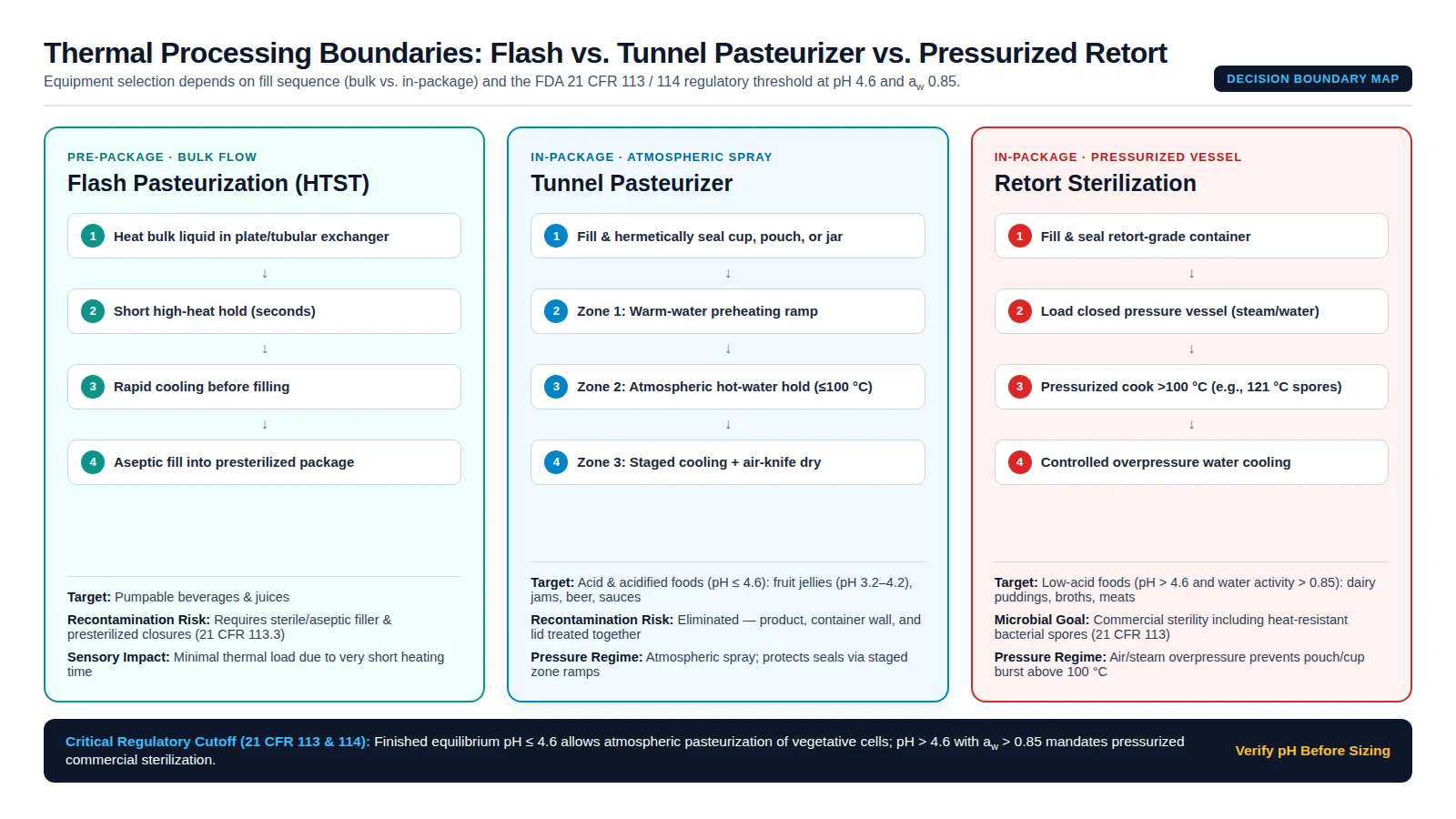
Finished equilibrium pH 4.6 and water activity 0.85 separate atmospheric tunnel pasteurization from closed pressurized retort sterilization. Acid and acidified foods at pH 4.6 or below can be stabilized by pasteurization targeting vegetative pathogens and spoilage flora, whereas low-acid foods with pH above 4.6 and water activity above 0.85 require pressurized retort sterilization to destroy heat-resistant bacterial spores.
Conventional thermal processing separates pasteurization from sterilization by microbial lethality target. Pasteurization eliminates vegetative pathogens and spoilage organisms while leaving heat-resistant bacterial spores potentially viable, resulting in a finite shelf life unless combined with acidity or refrigeration. Sterilization aims to remove all bacterial contaminants including spores—whose benchmark thermal resistance is evaluated at 121 °C, where reported spore D-values in pH 7.0 phosphate buffer reach 0.5 min—to achieve commercial sterility for long-term nonrefrigerated storage.
Under U.S. Food and Drug Administration acidified-food regulations, acid foods carry a natural pH of 4.6 or below, while acidified foods are low-acid foods formulated with added acid to reach a finished equilibrium pH of 4.6 or below and water activity above 0.85 (jams, jellies, and preserves are specifically listed alongside acid foods). Acidified products must receive thermal treatment sufficient to destroy vegetative cells of public-health and spoilage organisms under expected storage conditions, and whenever finished equilibrium pH exceeds 4.0, processors must verify finished equilibrium pH using potentiometric measurement. Scheduled processes must be established by a qualified authority under § 114.83, and any process deviation or finished pH above 4.6 triggers reprocessing or low-acid thermal processing under § 114.89.
Low-acid foods—defined as foods other than alcoholic beverages with finished equilibrium pH greater than 4.6 and water activity greater than 0.85, excluding tomatoes and tomato products below pH 4.7—must be processed in closed pressurized retorts capable of reaching sterilizing temperatures such as 121 °C. In pressurized water-immersion still retorts, water must cover the top layer of containers throughout come-up and processing while headspace air pressure is maintained between the water level and retort shell to counter internal pack expansion, and retort temperature-indicating devices must be accurate to 1 °F (0.5 °C).
| Selection Parameter | Atmospheric Tunnel Pasteurizer | Pressurized Retort Sterilizer |
|---|---|---|
| Regulatory Food Classification | Acid foods and acidified foods at finished equilibrium pH 4.6 or below | Low-acid foods with finished equilibrium pH above 4.6 and water activity above 0.85 |
| Microbial Inactivation Target | Vegetative pathogens and spoilage organisms (spores may survive) | Commercial sterility rendering food free of reproducing microbes and public-health spores |
| Vessel & Pressure Regime | Continuous open-ended atmospheric spray tunnel | Closed pressure vessel with steam or water plus controlled air overpressure |
| Operating Temperature Range | Atmospheric water-spray cycles (60 °C beverage to 80–90 °C jelly bath) | Pressurized sterilization evaluated at 121 °C for bacterial spores |
| Representative Jelly & Dessert Products | Acidified fruit jelly cups (pH 3.2–4.2), konjac fruit sticks, jams, fruit purees | Neutral-pH milk puddings, egg custards, low-acid dairy or coconut gels |
| Process Instrumentation Mandate | Zone spray temperature control, belt speed, routine container seal checks | Calibrated indicating sensors accurate to 1 °F (0.5 °C) and permanent temperature records |
How Does Staged Spray Control Prevent Lid Bulging and Thermal Shock?
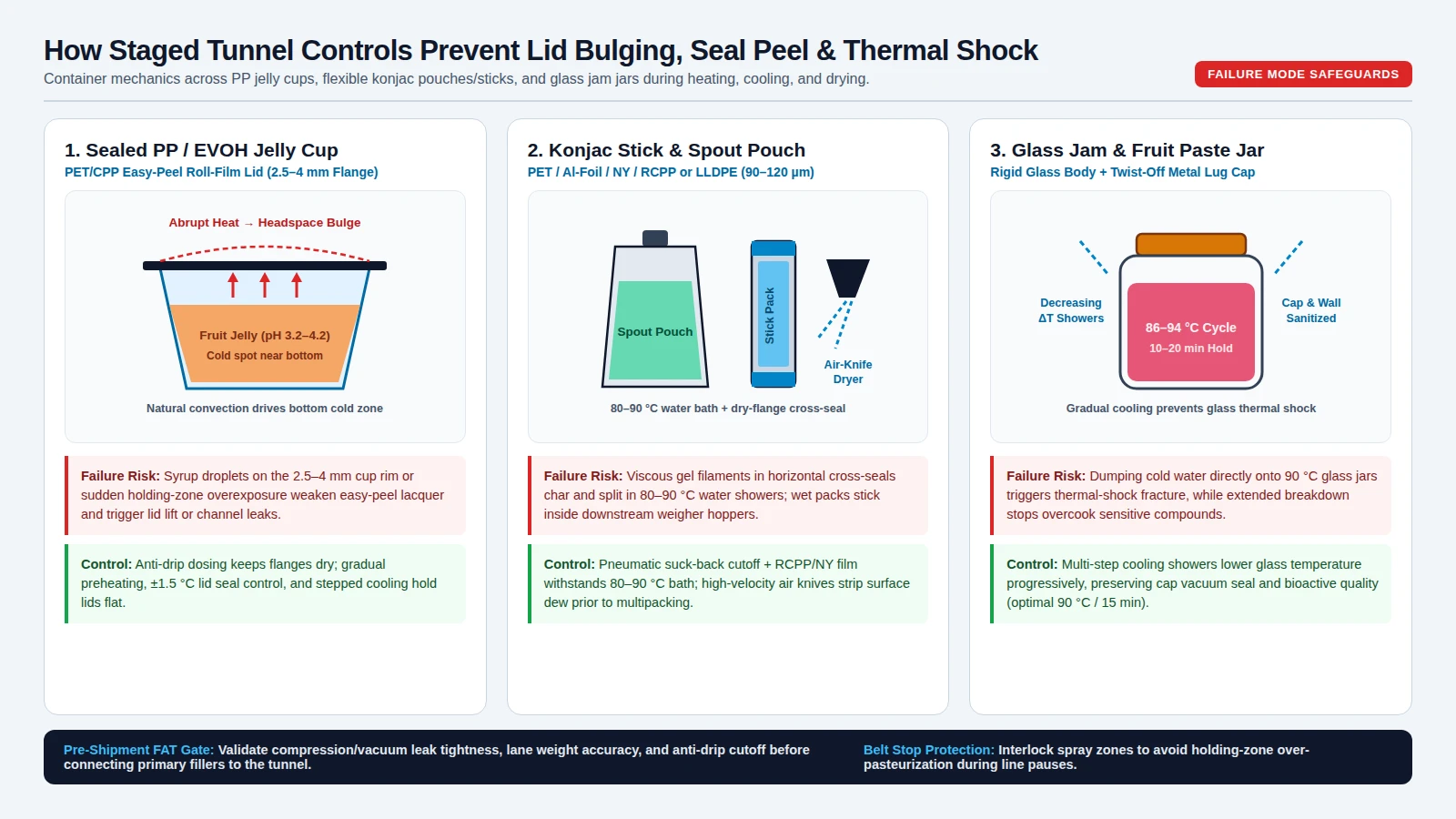
Staged preheating and decreasing-temperature cooling showers prevent container deformation by matching thermal ramp rates to package pressure resistance and wall thickness. When sealed packages enter hot water abruptly or remain trapped in the heating zone during a conveyor stoppage, expanding headspace gas builds internal pressure above seal or lid strength, causing lid bulging, peel-seal delamination, or glass thermal-shock fracture.
Internal pressure during in-package pasteurization rises with pasteurization temperature, headspace volume, dissolved gas concentration, and dwell duration, while survival depends on container wall thickness and seal strength. Commercial brewery records demonstrate that breakdown events stranding containers inside the heating zone for prolonged durations cause sharp spikes in bulged units, making belt-stop spray interlocks and rapid cool-down bypasses essential on any continuous tunnel.
Upstream filling and sealing quality determines whether flexible jelly packs survive 80–90 °C water showers without leaking. On rotary and linear jelly cup machines, positive anti-drip nozzle cutoff keeps syrup droplets off the 2.5–4 mm cup rim flange while independent PID thermocouple loops hold multi-across linear sealing heads within ±1.5 °C. Selecting matched barrier structures—covered in detail in our hot-fill jelly dosing and film specifications—further stabilizes seals: konjac and collagen stick packs rely on 90–120 micron PET/Al-Foil/NY/RCPP or LLDPE laminates that seal cleanly at 85 °C, while clear fruit jelly cups pair PP or barrier PP/EVOH/PP bodies with PET/CPP or modified-PE easy-peel lids.
| Failure Mode in Tunnel | Root Thermal or Mechanical Cause | Upstream & Tunnel Countermeasure |
|---|---|---|
| Jelly cup lid bulging or peel-back | Abrupt headspace expansion or weak seal lacquer on syrup-wet 2.5–4 mm flange | Anti-drip nozzle cutoff, ±1.5 °C PID heat-ring control, gradual preheating, and stepped cooling |
| Stick pack or pouch seam weeping | Viscous gel tail trapped in cross-seal splitting under 80–90 °C water bath | Pneumatic suck-back cutoff, 90–120 micron PET/Al-Foil/NY/RCPP laminate, FAT leak verification |
| Over-pasteurized bulged batches during jams | Downstream stoppage stranding sealed containers inside the heating zone | Belt-stop interlocks that switch holding-zone sprays to cooling water and log process deviations |
| Glass jam jar thermal-shock cracking | Sudden cold-water quench contacting hot glass right after 86–94 °C holding | Multi-stage cooling showers using progressively decreasing water temperatures |
| Wet packs jamming secondary weighers | Residual cooling-bath droplets carried into multihead weigher hoppers or cartons | High-velocity air-knife blow-off drying immediately downstream of final cooling |
Federal acidified-food controls also require container testing and visual or physical examinations frequent enough to verify protection against leakage or contamination. Before connecting primary fillers to a tunnel pasteurizer, run the compression-plate and vacuum-jar bubble checks detailed in our jelly line FAT and leak checklist so micro-channels are eliminated prior to full-line commissioning.
What Drives Tunnel Pasteurizer Sizing and Line Specification on Jelly Lines?
Tunnel pasteurizer equipment sizing, floor footprint, and specification complexity scale with six engineering factors rather than container speed alone: container volume and height-to-diameter geometry, initial fill temperature, target holding duration, number of stepped preheat and cooling zones, stainless steel metallurgy for acidic washdowns, and downstream drying plus surge-buffer integration.
Upstream-to-Downstream Line Integration Checklist
- Confirm equilibrium pH and scheduled-process hold duration first: Verify whether your fruit jelly or jam maintains finished equilibrium pH at or below 4.6 (typical acidic fruit jellies run pH 3.2–4.2) and have a qualified processing authority establish the scheduled hold temperature and time under § 114.83 before fixing tunnel belt area.
- Measure coldest-container initial temperature: Under federal thermal-processing definitions, initial temperature is the average temperature of the coldest container at cycle start after thorough mixing. Hot-filling jelly up to 85 °C enters the preheating zone far warmer than ambient-filled jars, cutting preheating length and steam demand.
- Account for container geometry and come-up rate: Larger container volumes spanning 330 mL, 500 mL, and 1000 mL and tall vertical jars slow natural convection, extending come-up time and total conveyor footprint unless containers are laid horizontally. Increasing heating water bath temperature from 60 to 80 °C shortens container come-up times by 12–15%.
- Match metallurgy and seals to fruit acids: Acidic fruit syrups containing citric or malic acid at pH 3.2–4.2 call for SUS316L stainless steel on wetted contact surfaces paired with food-grade PTFE or EPDM seals to resist corrosion across multi-shift sanitation.
- Integrate air-knife drying and surge buffering ahead of secondary bagging: Pair the tunnel cooling discharge with high-velocity air knives to strip surface droplets off PP cups and stick packs before elevation into a dimpled multihead weigher feeding an LV-210 premade zipper bagger or VFFS line, and install accumulation conveyors to buffer brief secondary film-splice pauses without stopping the hot-fill primary machine.
To align tunnel sizing with your primary cup, stick, or pouch filler, explore our jelly packing machines overview or send your container drawings, target pH, fill temperature, and hourly output through the project brief.
Frequently Asked Questions
Can a tunnel pasteurizer process low-acid milk pudding cups without refrigeration?
No—low-acid foods with a finished equilibrium pH above 4.6 and water activity above 0.85 cannot rely on atmospheric tunnel pasteurization for nonrefrigerated shelf stability. Because pasteurization may not inactivate heat-resistant bacterial spores, low-acid dairy puddings or custards require closed pressurized retort sterilization achieving commercial sterility at temperatures such as 121 °C.
Why does the coldest spot sit near the bottom of a sealed container?
During water-bath or spray heating of liquid and semi-liquid containers, warmer less-dense fluid rises toward the lid while cooler denser fluid settles downward by natural convection. CFD thermal simulations confirm that this circulation pattern consistently places the hot spot near the top and the slowest-heating cold spot near the bottom, where temperature validation probes should be located.
What happens if a conveyor breakdown stops jelly cups inside the heating zone?
Extended unintended holding inside the heating zone causes continuous headspace gas expansion and prolonged thermal load on lid seal lacquer, which commercial production records link directly to sharply elevated rates of bulged containers and degraded sensory attributes. Tunnels should incorporate belt-stop spray interlocks and deviation protocols aligned with § 114.89 so stalled lots are cooled safely and evaluated before release.
Why are high-velocity air knives required immediately after the cooling zone?
Containers exit the final cooling-water shower coated in surface droplets that cause flexible stick packs and PP cups to cling inside multihead weigher hoppers, disrupt target gram dosing, and dampen retail cartons. High-velocity air-knife blow-off blowers mounted between the cooling conveyor and incline elevator strip surface moisture cleanly before secondary LV-210 or VFFS bagging.
What packaging film layers tolerate hot-fill and atmospheric tunnel pasteurization?
Jelly packaging laminates must withstand hot-fill contact up to 85 °C alongside 80–90 °C atmospheric water-bath pasteurization without delaminating. Konjac and collagen stick lines commonly run 90–120 micron PET/Al-Foil/NY/RCPP or LLDPE structures for burst toughness and clean heat sealing, whereas clear fruit jelly cups pair PP or barrier PP/EVOH/PP cups with PET/CPP or modified-PE easy-peel lidding film.
Sources
- Heliyon / PubMed Central: Mathematical modeling and optimization of pasteurization for the internal pressure and physical quality of canned beer
- Foods / PubMed Central: Effect of Tunnel Pasteurization on Packaged Olive Paste in Glass Containers
- ACS Omega / PubMed Central: Time-Dependent Heat Transfer Coefficients of Standard Cans during Pasteurization
- Foods / PubMed Central: Effect of Hurdle Approaches Using Conventional and Moderate Thermal Processing Technologies for Microbial Inactivation in Fruit and Vegetable Products
- U.S. Electronic Code of Federal Regulations (eCFR): FDA Acidified Foods Regulation
- U.S. Electronic Code of Federal Regulations (eCFR): FDA Thermally Processed Low-Acid Foods Packaged in Hermetically Sealed Containers
Matching LINEVO Equipment in This Category
Further Engineering Reference
Automatic Jelly, Energy Gel, Cup Fill-Seal & Gummy Packaging Machines
Compare LINEVO jelly packing machines across 4–16 lane heated-piston gel stick lines, CIP cup sealers, LV-160 spout fillers, and LV-210 / VFFS gummy baggers.
Open Technical SheetHot-Fill Jelly Dosing Pumps, CIP Hoppers & Barrier Laminate Specifications
Engineering specification guide for jacketed heated hoppers, rotary-valve piston dosing, anti-drip nozzles, SUS316L CIP manifolds, and retort/hot-fill jelly films.
Open Technical SheetTurnkey Primary Jelly Filling, Secondary Multipack Weighing & Cartoning Lines
Configure turnkey LINEVO jelly lines from multi-lane stick or CIP cup fillers through cooling and drying to LV-210 zipper multipack baggers and cartoners.
Open Technical SheetAutomatic SUS304/316L CIP Jelly, Pudding & Fruit Cup Filling-Sealing Machines
Specifications for LINEVO automatic cup filling and roll-film lid sealing machines with SUS304/316L CIP sanitation and industrial PLC + HMI control.
Open Technical SheetHot-Fill Jelly FAT Protocol, Lane Weight Audit & Seal Leak Checklist
Pre-shipment Factory Acceptance Test (FAT) checklist for LINEVO multi-lane jelly stick machines, CIP cup sealers, LV-160 spout fillers, and LV-210 pouch lines.
Open Technical Sheet