What It Is Built For vs. When to Choose Another Configuration
Target Products & Production Duty
- Nutraceutical, functional snack, and sports nutrition co-packers running high-volume narrow stick packs of konjac jelly, collagen gel, carbohydrate energy gels, and electrolyte concentrates.
- Hot-fill hydrocolloid formulations (carrageenan/konjac/xanthan) that gel if cooled prematurely and require a double-walled heated hopper with mechanical paddle agitation.
- Sanitary multi-shift plants requiring SUS304/316 product-contact pipelines and CIP clean-ready interfaces.
Better-Matched Sibling Configurations
Flat 4-side-seal gel sachets (50–125 mm wide, 5–100 ml) instead of narrow tubular back-seal sticks
LV-500SY / 700SY / 980SY 4-Side-Seal Gel Sachet Machine →Gels containing suspended fruit pulp, chia seeds, or konjac pearls requiring particulate-tolerant valve clearances
Multi-Lane Particulate Gel Pouch Machine →Rigid thermoformed or premade fruit-jelly and pudding cups with roll-film lidding
Automatic CIP Jelly & Sauce Cup Fill-Seal Machine →
Specification Table (Metric & Imperial)
| Parameter | Metric Specification | Imperial Equivalent | Operating Condition & Verification Note |
|---|---|---|---|
| Equipment Family | LINEVO T03 Multi-Lane Liquid/Gel Stick Series | — | Lane count and parent web width are selected around your target hourly stick output. |
| Dosing Architecture | Multi-lane rotary piston pump matrix (1 channel per lane) | — | Engineers validate fill settings and discharge behavior with your actual gel and target dose. |
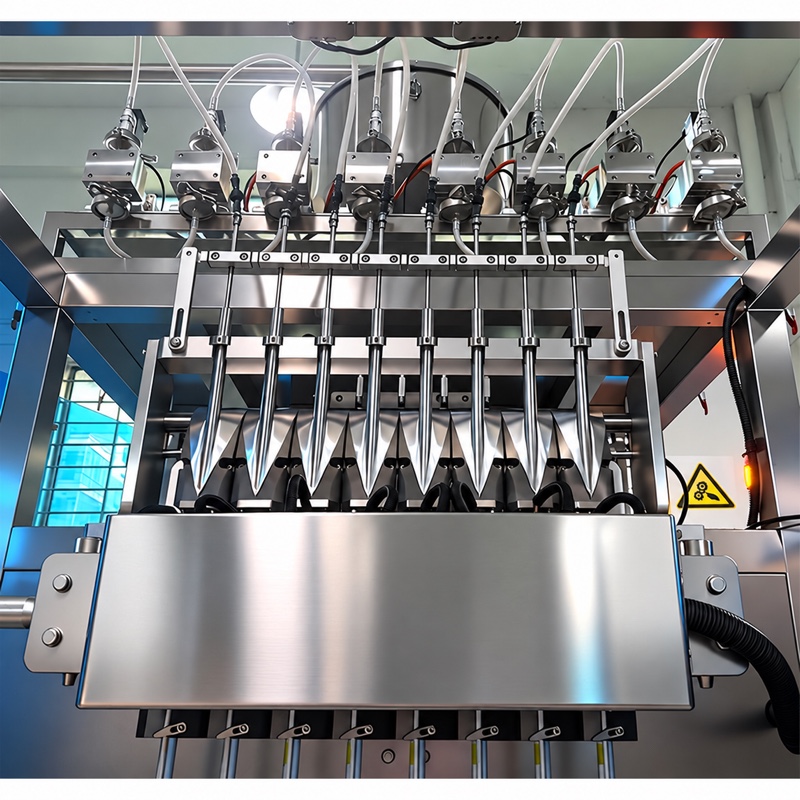
| Nozzle Shut-Off | Pneumatic suck-back anti-dripping shut-off nozzle per lane | — | Prevents viscous gel tails from contaminating horizontal heat-seal zones. |
| Hopper Thermal Control | Double-walled jacketed heated hopper + heavy-duty mixing paddles | — | Maintains low, uniform fluid viscosity on hot-fill konjac, pectin, and syrup gels. |
| Sanitary Construction | Full SUS304/SUS316 stainless build + CIP clean-ready interface | — | Specify SUS316 contact grade for low-pH acidic fruit/citric energy gels in quotation. |
Shift Production Reality Note: Listed cycle speeds depend on container or bag volume, target fill weight, and material flow characteristics. For multi-shift plant planning, multiply nominal run rate by a 0.70–0.85 shift OEE factor (accounting for film/label splices, hopper refills, and routine cleaning) and confirm exact speed with your samples during Foshan FAT.
What Is Included vs. What We Review With You
Core Station Scope
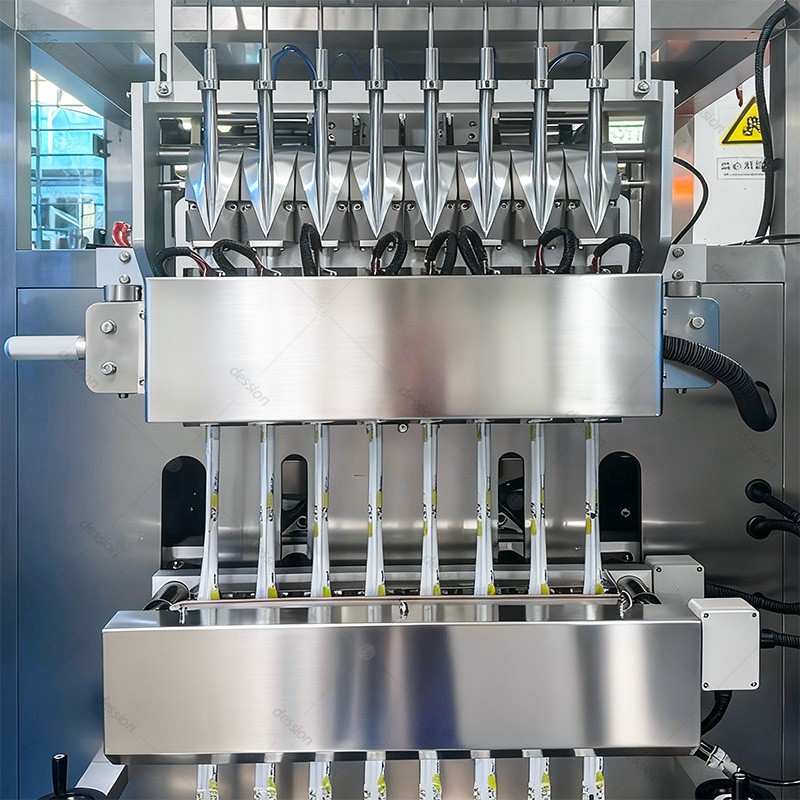
- SUS304/316 stainless chassis, multi-lane rotary film slitter, forming tubes, and vertical/horizontal heat-sealing bars
- Double-walled jacketed electric thermal-retention hopper with mechanical paddle agitator
- Pneumatic mechanical suck-back anti-dripping shut-off nozzle on every lane
- CIP clean-ready sanitary pipeline interface
Reviewed Against Your Samples & Plant
- Advanced Mechanical/Servo Rotary Piston Pump Matrix cylinder bore sized to exact ml/g dose
- High-Speed Servo-Driven Web Slitting & Pulling Array matched to lane count and stick width
- Tear-notch / shaped-top die cutter, parent-web lot coder, and plant electrical/air supply
Verified Electrical, Sensing & Pneumatic BOM
PLC Motion & Sequence Controller
Main programmable logic controller coordinating multi-lane rotary piston dosing, film/cup indexing, jacket heating, and sealing interlocks.
Rotary Encoder, Control Relays & 24V Switching Power Supply
Phase-angle timing feedback, cabinet switching relays, and regulated 24V DC power supply across multi-lane stick, sachet, and cup stations.
HMI Color Touchscreen & Variable Frequency Drive (VFD)
Multi-recipe touchscreen terminal storing lane dose/temperature profiles and inverter motor speed control for main drives and conveyors.
Pneumatic Cylinders, Solenoid Valves, Vacuum Gauge & FRL Unit
Suck-back anti-drip nozzle actuators, cross-sealing cylinders, manifold valves, pouch-opening vacuum gauge, and air preparation unit.
Representative electrical, sensing, and pneumatic hardware fitted on LINEVO packaging configurations; exact part series or project-specified alternatives are itemized in your written quotation BOM.
How It Works & Mechanical Countermeasures to Common Line Failures
- 01Heated Agitated Conditioning
Hot-fill konjac or carbohydrate gel stays homogeneous and free-flowing inside the jacketed heated SUS304/316 hopper.
- 02Parent Foil Slitting & Stick Forming
Servo-pulled parent film slits into parallel lane ribbons, wrapping around stainless forming tubes for vertical back-sealing.
- 03Synchronized Rotary Piston Dosing & Suck-Back
Independent piston channels meter exact gel volume per lane, ending with a pneumatic suck-back cutoff.
- 04Hermetic Cross-Sealing & Tear-Notch Cutting
Horizontal jaws seal clean dry film layers, punch easy-tear notches, and discharge finished gel sticks.
Production Floor Failure Modes & LINEVO Countermeasures
Syrup & Hydrocolloid Stringing Across Cross-Seal Jaws ('Leaker Batches')
Floor Risk: Sticky maltodextrin or konjac gel pulls a hair-thin filament off standard open nozzles, charring inside horizontal jaws and leaking in pasteurizers.
Mechanical Countermeasure: Each lane integrates a pneumatic mechanical suck-back anti-dripping shut-off nozzle that retracts the last drop cleanly before jaw closure.
Premature Konjac/Carrageenan Pre-Gelling Inside Cold Hoppers
Floor Risk: Unheated hoppers let jelly sol drop below its 55–65 °C setting point, causing outer lanes to under-dose.
Mechanical Countermeasure: The double-walled jacketed hopper combines electric thermal heating with heavy-duty mixing paddles to keep viscosity uniform across all lanes.
Lane-to-Lane Dose Imbalance on Shared Manifold Fillers
Floor Risk: Single-pump manifolds starve outer lanes whenever viscous sports gel thickens slightly.
Mechanical Countermeasure: Independent rotary piston dosing channels meter each stick lane positively.
Hours Lost Disassembling Sticky Gel Tubes Between Flavors
Floor Risk: Dried sugar/collagen residue inside dead-leg fittings triggers microbial risk and long manual tear-downs.
Mechanical Countermeasure: Full SUS304/316 sanitary piping with a CIP clean-ready interface speeds flavor-to-flavor flush cycles.
Comparing Quotations? Check These 5 Things
Multiply cycle rate (20–40 cuts/min) by lane count and a realistic 0.70–0.85 shift OEE factor accounting for hot-fill hopper replenishment, parent reel splices, and CIP sanitation.
Verify whether double-walled jacketed heating, mixing paddles, rotary-valve piston dosing, and pneumatic suck-back shut-off nozzles are sized for your gel viscosity and particulate size.
Confirm product-contact steel grade for acidic fruit gels, electrical heater load (kW, voltage/phase), and dry compressed air consumption (0.6–0.8 MPa) on the written scope sheet.
Check parent rollstock maximum width (420 / 500 / 700 / 980 mm), lane pitch, tear-notch punch geometry, and cup cavity rings against approved dieline drawings before plate engraving.
Require a filmed Foshan FAT running viscous gel or gummy samples at target fill temperature to verify zero seal-zone stringing, weight uniformity across lanes, and burst resistance.
From Sample Audit to Foshan FAT & Export Commissioning
- 01Sample Audit
Send physical containers, pouches, lids, film reels, or product specs to Foshan so engineers verify dimensions, flow behavior, and station geometry.
- 02Written Scope Freeze
Confirm exact model/lane count, included vs. project-reviewed modules, electrical/air utilities, and format parts in the technical quotation.
- 03Foshan Fabrication & Wiring
CNC machining, stainless frame assembly, PLC/HMI programming, and inline station synchronization inside LINEVO's 15,000+ m² Foshan plant.
- 04Foshan FAT Run Before Shipment
Full-speed trial on sample materials verifying registration, dosing/vacuum stability, seal integrity, and fault interlocks on video or in person.
- 05Export Crating & Commissioning
Fumigation-free export crating, English schematics, parameter backups, wear-part list, and remote video or scheduled on-site commissioning.
Frequently Asked Questions
What is the highest hot-fill temperature the jacketed hopper and piston pumps support?
Share your exact cooking/holding temperature (typically 65–85 °C for konjac/carrageenan jelly) and pH during project scoping so hopper jacket wattage, seals, and SUS316 contact steel are matched in the quotation.
How do I calculate parent film width for a 6-lane or 8-lane konjac stick pack?
For back-seal sticks, single-lane ribbon width = (2 × finished stick width) + fin-seal overlap (12–16 mm), multiplied by lane count. Run your dimensions in our Parent Film Width Calculator (/tools/jelly-cup-and-stick-film-chart/).
Can this machine punch shaped bottle-neck tear tops on gel sticks?
Confirm straight cut, zigzag tear notch, or shaped contour die punching during sample audit—each cut profile uses dedicated cross-cutter tooling.