Degrees Brix (°Bx) is a mass-percentage soluble-solids scale where 1 °Bx equals 1 g of sucrose in 100 g of aqueous solution at 20 °C (68 °F). In jam and jelly production, Brix enforces federal 65% soluble-solids standards, drives high-methoxyl pectin gelation above 60% solids, and sets density (1315.3 g/L at 65.0 °Bx) for piston dosing.
What Are the Units of Brix Measurement and Comparable Sugar Scales?
Degrees Brix (°Bx) expresses dissolved solids as a percentage by mass—specifically grams of sucrose per 100 g of solution at 20 °C (68 °F) under federal standard 27 CFR § 24.10. Comparable specific-gravity sugar scales include Plato (°P) in brewing, Oechsle in German and Swiss winemaking, Balling on older saccharimeters, and ICUMSA mass fraction.
Modern food and beverage instruments calculate mass fraction from official International Commission for Uniform Methods of Sugar Analysis (ICUMSA) tables while reporting the displayed value in °Bx. Historically, Karl Balling measured sucrose specific gravity to 3 decimal places, Adolf Brix refined the table to 5 decimal places at 17.5 °C referenced to water at 4 °C, and Fritz Plato’s Normal-Eichungs Kommission extended precision to 6 decimal places at 20 °C. Today, both National Bureau of Standards (NBS) and American Society of Brewing Chemists (ASBC) tables report apparent specific gravity at 20°C/20°C.
| Sugar Measurement Scale | Unit Symbol | Primary Industry Usage | Benchmark Reading at 1.040 Apparent SG (20°/20°C) | Historical / Reference Basis |
|---|---|---|---|---|
| Brix Scale | °Bx | Fruit juice, jam, jelly, wine, soft drinks, sugar refining | 9.99325 °Bx | Percent sucrose by mass; NBS 20°/20°C & ICUMSA |
| Plato Scale | °P | Commercial brewing and wort analysis | 9.99359 °P | ASBC 20°/20°C; within ±0.0005 °Bx across most liquids |
| ICUMSA Mass Fraction | % (m.f.) | Sugar chemistry, laboratory calibration, digital meters | 9.99249% | Official ICUMSA density and refractometry polynomials |
| Balling Scale | °Balling | Legacy saccharimeters, select breweries & South African wine | Comparable to °Bx | Oldest sucrose table; 3-decimal specific gravity |
| Oechsle Scale | °Oe | German, Swiss, and Luxembourg winemaking | Direct must-density scale | Specific-gravity-derived sugar scale for grape must |
Across virtually all fruit-processing operations, °Bx and °P are interchangeable within ±0.0005 °Bx, diverging by at most 0.002 °P near 0 °Bx because NBS and ASBC adopted slightly different reference values for air and pure water density.
How Much Dissolved Sugar Is in 1 Degree Brix?
One degree Brix equals exactly 1 g of dissolved sucrose in 100 g of total aqueous solution—meaning a 1 °Bx reference solution mixes 1 g of sucrose with 99 g of pure water (1% sugar by mass). In real fruit purees, jams, and jellies containing mixed sugars, organic acids, and minerals, °Bx approximates total dissolved solids rather than pure sucrose alone.
Because fruit formulations contain glucose, fructose, citric or malic acid, soluble pectin, and minerals alongside added sucrose, the reading derived from refractive index and ICUMSA tables is formally defined as Refractometric Dry Substance (RDS)—an equivalent sucrose percentage by mass. Non-sucrose sugars track close to actual mass concentration: an 11.0% by mass D-glucose solution measures 10.9 °Bx on a handheld refractometer.
Organic acids and fermentation byproducts introduce measurable offsets that quality teams must account for during batch verification:
- Citrus Acid Interference: Under FDA juice-labeling rules in 21 CFR § 101.30, refractometer Brix values measured on citrus juices may be corrected for citric acid so high acidity does not inflate apparent sugar solids.
- Salt and Mineral Density Shifts: Because dissolved salt is denser than sucrose at equal volume, a brine solution registers higher apparent °Bx than an equal-volume sugar solution.
- Fermentation Bias in Opposite Directions: Ethanol has a higher refractive index (1.361) than pure water (1.333), causing fermenting fruit bases to read artificially high on a refractometer while reading artificially low on a specific-gravity hydrometer.
How Do You Measure Jam and Jelly Brix With a Refractometer?
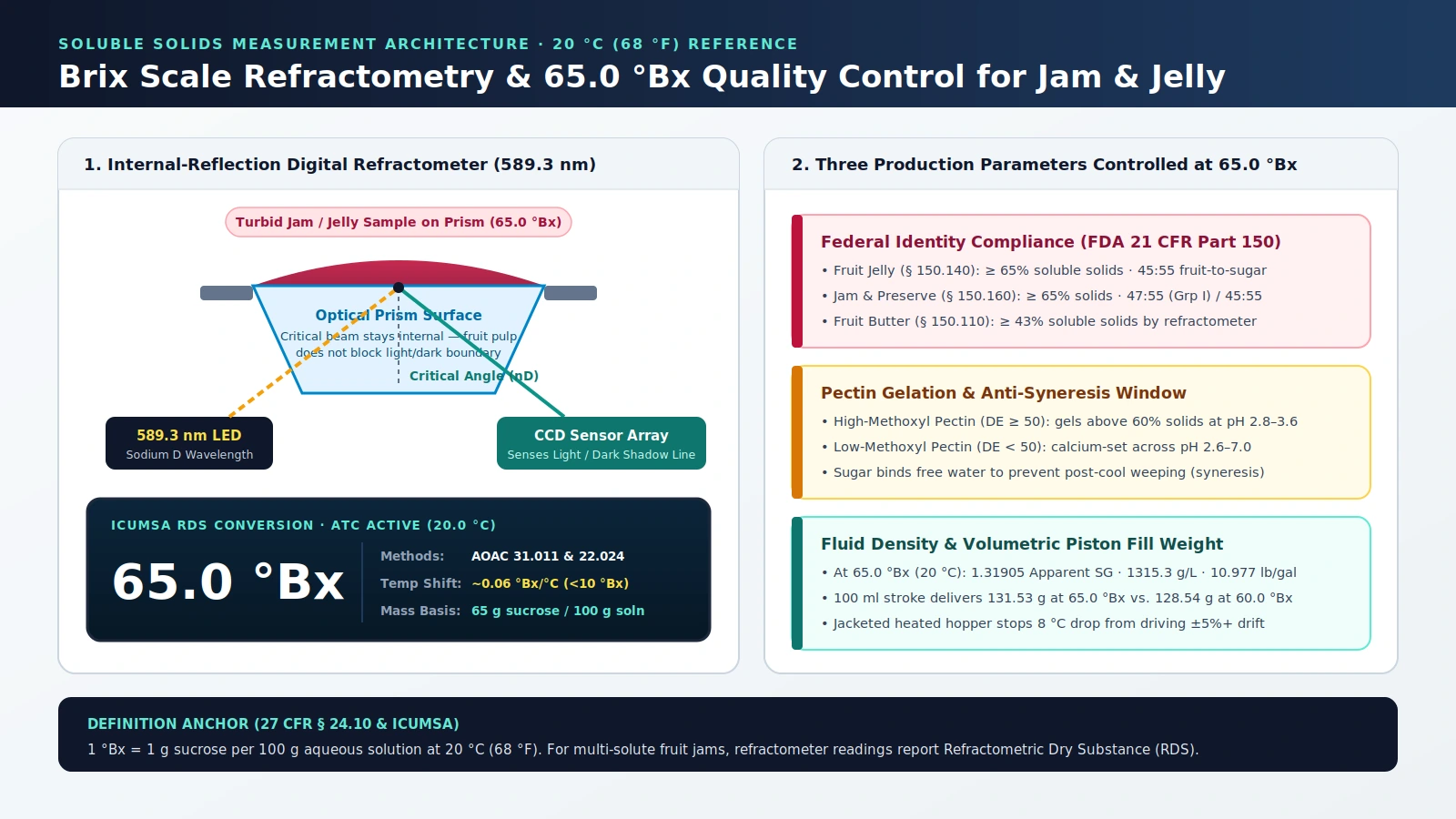
Refractometers measure the refractive index (nD) of a fruit sample at the sodium D-line wavelength of 589.3 nm referenced to 20 °C and convert that optical angle to °Bx using ICUMSA tables. For turbid fruit jams and particulate purees, digital internal-reflection refractometers with Automatic Temperature Compensation (ATC) deliver faster, cleaner readings than optical Abbe eyepieces.
Optical Abbe-based handheld and bench refractometers pass light through a sample droplet placed on a prism so the operator reads a dark-bright critical-angle boundary against an engraved Brix scale. By contrast, digital refractometers keep the critical light path entirely internal to the prism and detect the shadow boundary with a charge-coupled device (CCD) sensor array—preventing suspended fruit pulp, seeds, or opaque pectin haze from blurring the line.
| Brix Measurement Instrument | Operating Principle | Best Fit on Jam & Jelly Lines | Key Limitation & Calibration Check |
|---|---|---|---|
| Digital Critical-Angle Refractometer | Internal prism reflection (589.3 nm) sensed by CCD array | Benchtop QC and turbid jams, preserves, and fruit purees | Requires ATC or 20 °C prism equilibration; reports RDS |
| Optical Abbe Refractometer | Eyepiece observation of critical-angle dark-bright boundary | Clear fruit juices and strained fruit jellies | Turbid pulp softens shadow line; manual thermometer correction |
| Hydrometer / Oscillating U-Tube Meter | Buoyancy or oscillating-tube density converted via NBS/ICUMSA tables | Thin single-strength juices, liquid sugar, and beverage syrups | High-viscosity cooked jams trap bubbles and resist hydrometers |
| Inline MIR / NDIR / FT-IR Sensor | Mid-infrared absorption spectra with up to five analyzing channels | Continuous evaporator and syrup-blending pipelines | Calibrated against pure sucrose; corrects interfering ingredients |
Controlling Temperature Drift and Following Federal AOAC Refractometer Methods
Refractive index shifts sharply with sample temperature. For sucrose solutions below 10 °Bx, a 1 °C temperature change shifts the measured Brix value by about 0.06 °Bx. When sample and prism cannot be equilibrated closely to 20 °C—such as hot jam drawn straight from a vacuum cooker—operators should enable verified ATC or take readings at 2 temperatures separated by a few degrees to calculate the Brix-per-degree slope and reference the final value back to 20 °C.
Federal identity testing specifies two distinct Association of Official Analytical Chemists (AOAC) 13th Edition (1980) protocols incorporated by reference in U.S. food standards:
- Standardized Fruit Jelly (21 CFR § 150.140): Finished soluble solids must be verified using AOAC section 31.011 (“Solids by Means of Refractometer—Official Final Action”).
- Standardized Fruit Jam and Preserve (21 CFR § 150.160): Finished soluble solids must be verified using AOAC section 22.024 (“Soluble Solids by Refractometer in Fresh and Canned Fruits, Jellies, Marmalades, and Preserves—Official Final Action”), explicitly making no correction for water-insoluble solids such as fruit fibers or seeds.
What Is the Brix Scale Formula and Where Do Polynomials Stop Working?
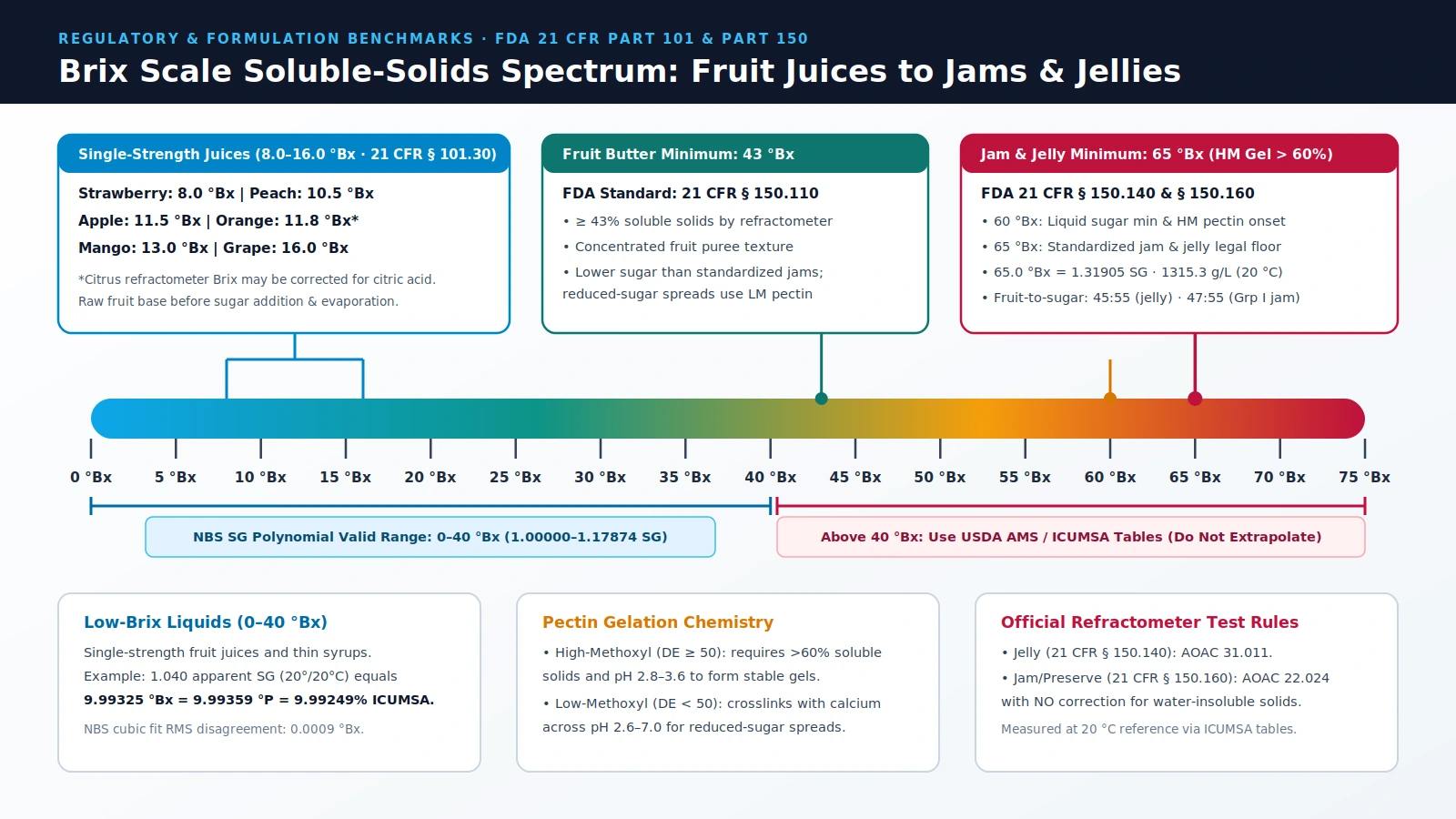
Between 0 and 40 °Bx (apparent specific gravity 1.00000 to 1.17874 at 20°C/20°C), degrees Brix converts directly from apparent specific gravity (SG) using two NBS-derived equations: the quick approximation °Bx = 263.663 − 263.806 / SG, or the high-accuracy cubic polynomial °Bx = 182.46007 SG³ − 775.68212 SG² + 1262.7794 SG − 669.56218 with an RMS disagreement of 0.0009 °Bx.
Both equations are strictly bounded to the 0 to 40 °Bx range (1.00000 to 1.17874 SG). Extrapolating either polynomial into the 60.0 to 69.0 °Bx cooking zone introduces avoidable conversion error during jam batching and filler calibration. Once fruit concentrates, liquid sugar (minimum 60 °Bx under 27 CFR § 24.10), or cooked jellies climb above 40 °Bx, plant engineers should look up exact density and apparent specific gravity directly from tabulated USDA Agricultural Marketing Service (AMS) or official ICUMSA tables rather than relying on low-Brix polynomials.
How Does the Brix Scale Apply to Fruit Purees, Jams, and Jellies?
Raw single-strength fruit juices start between 8.0 and 16.0 °Bx for common preserve fruits under 21 CFR § 101.30—including strawberry at 8.0 °Bx, peach at 10.5 °Bx, apple at 11.5 °Bx, orange at 11.8 °Bx, mango at 13.0 °Bx, and grape at 16.0 °Bx. Cooking concentrates those fruit bases with nutritive sweeteners to at least 43% soluble solids for fruit butter and at least 65% soluble solids for standardized jams, preserves, and jellies.
Federal identity standards under 21 CFR Part 150 tie refractometric soluble solids directly to minimum fruit-to-sweetener mass ratios. For fruit jelly under 21 CFR § 150.140, the batch must combine at least 45 parts by weight of fruit juice ingredient to each 55 parts by weight of saccharine solids, calculated using statutory fruit-juice soluble-solids factors—such as 7.0 for grape, 7.5 for apple, and 12.5 for strawberry. For fruit jams and preserves under 21 CFR § 150.160, Group I fruits (such as strawberry, grape, blackberry, raspberry, orange, and cherry) require at least 47 parts fruit to 55 parts saccharine solids, whereas Group II fruits (such as apricot, peach, pear, plum, and fig) and mixed-group recipes require at least 45 parts fruit to 55 parts saccharine solids.
| Standardized Fruit Product Category | Federal Regulation | Minimum Soluble Solids (°Bx) | Statutory Fruit-to-Sweetener Ratio | Official Refractometer Protocol |
|---|---|---|---|---|
| Single-Strength Strawberry Juice | 21 CFR § 101.30 | 8.0 °Bx | 100 percent juice baseline | Refractometer Brix reference |
| Single-Strength Apple Juice | 21 CFR § 101.30 | 11.5 °Bx | 100 percent juice baseline | Refractometer Brix reference |
| Single-Strength Orange Juice | 21 CFR § 101.30 | 11.8 °Bx | 100 percent juice baseline | Citrus citric-acid correction permitted |
| Single-Strength Grape Juice | 21 CFR § 101.30 | 16.0 °Bx | 100 percent juice baseline | Refractometer Brix reference |
| Standardized Fruit Butter | 21 CFR § 150.110 | 43% (43 °Bx) | Concentrated fruit puree standard | AOAC refractometer method |
| Liquid Sugar Syrup | 27 CFR § 24.10 | 60% (60 °Bx) | Refined dry sugar in water | Percent pure dry sugar by weight |
| Standardized Fruit Jelly | 21 CFR § 150.140 | 65% (65 °Bx) | 45 parts fruit juice : 55 parts saccharine | AOAC 13th Ed. (1980) section 31.011 |
| Standardized Jam & Preserve (Group I) | 21 CFR § 150.160 | 65% (65 °Bx) | 47 parts fruit : 55 parts saccharine | AOAC 13th Ed. (1980) section 22.024 |
| Standardized Jam & Preserve (Group II) | 21 CFR § 150.160 | 65% (65 °Bx) | 45 parts fruit : 55 parts saccharine | AOAC 13th Ed. (1980) section 22.024 |
High-Methoxyl vs. Low-Methoxyl Pectin Gelation Thresholds
Reaching 65 °Bx is not solely a labeling hurdle—it sits squarely inside the physical gelation window of traditional pectin. High-methoxyl (high-ester) pectins, defined by a degree of esterification equal to or above 50, require soluble solids above 60% combined with a pH between 2.8 and 3.6 so dissolved sugar binds free water and allows pectin chains to crosslink through hydrogen bonds and hydrophobic interactions. Well-balanced pectin networks also minimize syneresis (liquid weeping) during warehouse storage.
When manufacturers formulate reduced-sugar fruit spreads or functional dessert gels below the 60% high-methoxyl threshold, they switch to low-methoxyl pectins (degree of esterification below 50). Low-methoxyl pectins crosslink using calcium ions instead of high sugar concentration, forming stable gels across a wider pH window from 2.6 to 7.0 at lower soluble solids.
How Do You Convert Brix Scale Readings to Specific Gravity for Filling and Dosing?
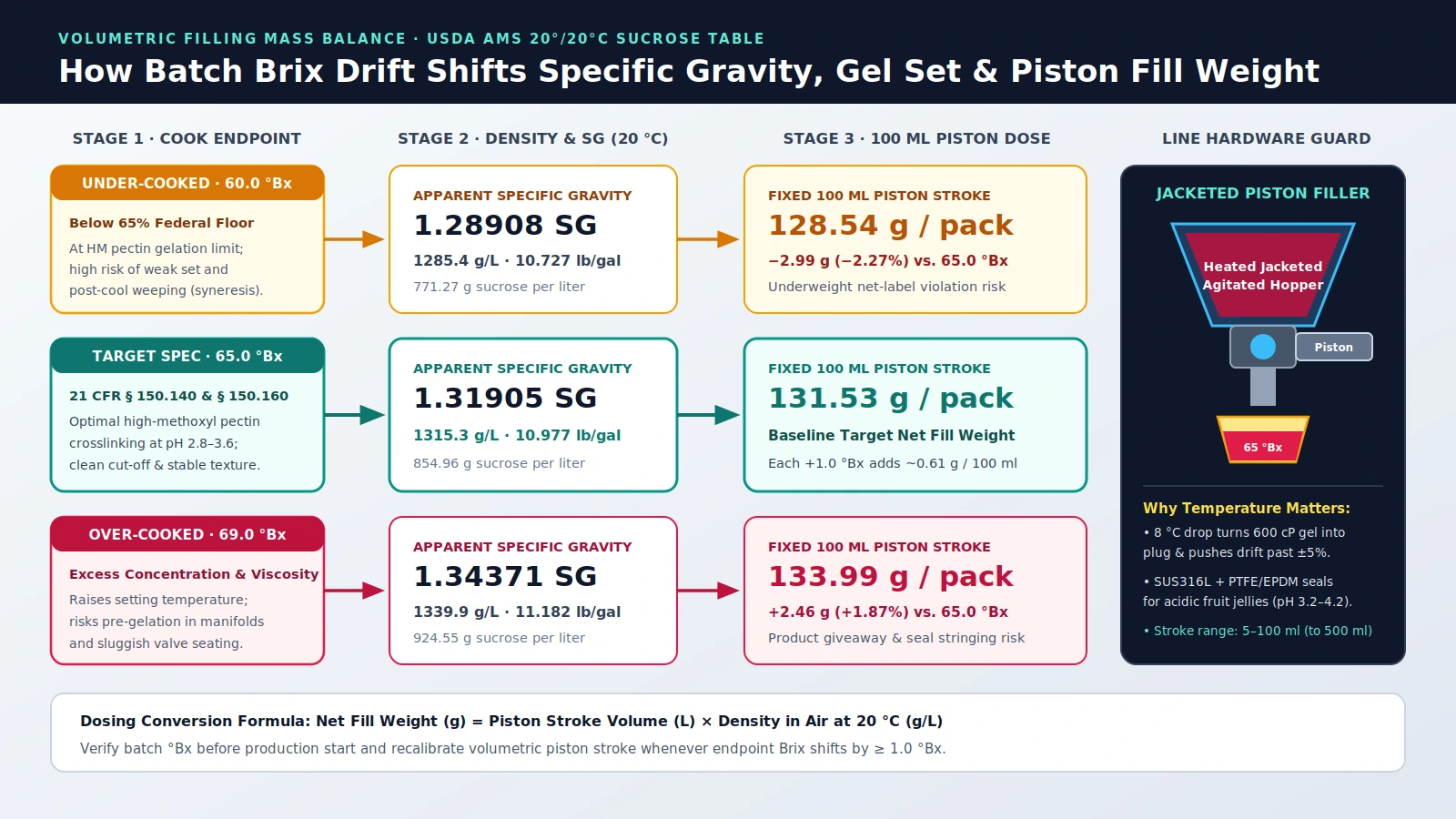
Across the 60.0 to 69.0 °Bx jam and jelly cooking band, apparent specific gravity (20°/20°C) in the USDA AMS sucrose table climbs from 1.28908 (1285.4 g/L) at 60.0 °Bx to 1.31905 (1315.3 g/L) at 65.0 °Bx and 1.34371 (1339.9 g/L) at 69.0 °Bx. Multiply volumetric piston displacement (in liters) by weight per liter in air to translate Brix readings directly into net pack weight.
Because rotary-valve pistons on a commercial jam filling machine or jelly filling machine meter fixed liquid volume rather than weighing each stroke inline, batch-to-batch Brix drift shifts finished gram weight automatically. Per 1 liter of cumulative volumetric piston displacement (such as 100 ml multi-lane strokes), a batch under-cooked to 60.0 °Bx delivers 1285.4 g, a compliant 65.0 °Bx batch delivers 1315.3 g, and an over-cooked 69.0 °Bx batch delivers 1339.9 g—all at the exact same mechanical stroke setting.
| Degrees Brix (°Bx) | Apparent Specific Gravity (20°/20°C) | Weight in Air at 20 °C (g/L) | Grams of Sucrose per Liter (g/L) | Weight per U.S. Gallon in Air (lbs) | Pounds of Sucrose per Gallon (lbs) |
|---|---|---|---|---|---|
| 60.0 °Bx | 1.28908 | 1285.4 | 771.27 | 10.727 | 6.436 |
| 62.0 °Bx | 1.30093 | 1297.3 | 804.31 | 10.826 | 6.712 |
| 64.0 °Bx | 1.31297 | 1309.3 | 837.93 | 10.926 | 6.993 |
| 65.0 °Bx | 1.31905 | 1315.3 | 854.96 | 10.977 | 7.135 |
| 66.0 °Bx | 1.32516 | 1321.4 | 872.14 | 11.027 | 7.278 |
| 68.0 °Bx | 1.33748 | 1333.7 | 906.93 | 11.130 | 7.568 |
| 69.0 °Bx | 1.34371 | 1339.9 | 924.55 | 11.182 | 7.716 |
Holding cook endpoint tightly around 65.0 °Bx protects both sides of the operating margin. Letting soluble solids slip toward 60.0 °Bx risks failing federal 65% identity standards, weakens high-methoxyl pectin set, encourages syneresis, and drops volumetric fill weight toward underweight label violations. Conversely, over-cooking toward 68.0–69.0 °Bx inflates net fill mass per volumetric stroke, wastes concentrated fruit solids, and elevates viscosity inside nozzles and manifold valves.
Preventing Viscosity Plugging and Weight Drift on Jam and Jelly Filling Lines
High-Brix jams and hydrocolloid jellies are equally sensitive to manifold heat loss. Dropping 8 °C inside an uninsulated feed pipe can transition a pumpable 600 cP gel into a semi-solid plug that stalls check-ball valves and pushes lane-to-lane weight variance past ±5%. Double-walled jacketed heated hoppers paired with positive-displacement rotary piston banks—spanning 5–100 ml (extensible to 500 ml) across 2–16 lanes at 20–40 cuts/min with 0.6–0.8 MPa air supply—hold fluid density and viscosity stable across full shifts.
For acidic fruit jellies operating at pH 3.2–4.2 with citric or malic acid, specifying SUS316L stainless steel wetted contact parts with food-grade PTFE or EPDM seals prevents acid corrosion during hot-fill production and washdown. To align your recipe’s soluble solids and particulate profile with downstream equipment, review our konjac, fruit, and supplement product setups, compare fruit-piece and paste gel setups, verify heated hopper engineering in hot-fill jelly dosing and barrier film specs, or inspect cup and pouch fillers on jelly cup and pouch machines.
For engineering teams standardizing cook-endpoint refractometry and piston stroke calibration across multiple fruit SKUs, share your target Brix, equilibrium pH, particle size, and pack volume via WhatsApp to request our jam and jelly Brix-to-specific-gravity QC record sheet.
Frequently Asked Questions
What are the units of the Brix scale?
The Brix scale is measured in degrees Brix (°Bx), where each degree represents 1% dissolved sucrose by mass, equal to 1 g of sucrose per 100 g of solution at 20 °C (68 °F). Modern digital instruments compute ICUMSA mass fraction and display the result in °Bx, which matches the Plato scale (°P) within ±0.0005 °Bx across most beverage and syrup concentrations.
How much sugar is in 1 degree Brix?
One degree Brix equals 1 g of sucrose dissolved in 99 g of water, totaling 100 g of 1% sugar solution by weight. Because fruit purees and jams contain glucose, fructose, organic acids, and soluble pectin alongside sucrose, refractometer readings report Refractometric Dry Substance (RDS) as equivalent sucrose content rather than pure sucrose alone.
What Brix level is required for commercial jams and jellies?
Under FDA standards of identity in 21 CFR § 150.140 (fruit jelly) and 21 CFR § 150.160 (fruit preserves and jams), finished products must contain not less than 65% soluble solids (65 °Bx) measured by AOAC refractometer methods. Standardized fruit butter under 21 CFR § 150.110 requires a lower minimum of 43% soluble solids.
Can you use standard Brix-to-specific-gravity polynomials for 65 °Bx jam?
No. The widely cited NBS conversion equations—including both the reciprocal approximation and the cubic polynomial with 0.0009 °Bx RMS error—are strictly valid only from 0 to 40 °Bx (1.00000 to 1.17874 apparent specific gravity). Above 40 °Bx, jam and jelly processors should read exact 20°/20°C density directly from USDA AMS or ICUMSA tables (such as 1.31905 SG and 1315.3 g/L at 65.0 °Bx).
Why does batch Brix drift change fill weight on a piston jam filling machine?
Volumetric piston fillers dispense a fixed liquid volume per stroke, so net pack weight scales directly with fluid density in grams per liter. In the USDA AMS 20°/20°C table, density rises from 1285.4 g/L at 60.0 °Bx to 1315.3 g/L at 65.0 °Bx and 1339.9 g/L at 69.0 °Bx—requiring stroke verification whenever batch Brix drifts.
Sources
- U.S. Electronic Code of Federal Regulations (eCFR): 21 CFR § 150.140 — Fruit jelly
- U.S. Electronic Code of Federal Regulations (eCFR): 21 CFR § 150.160 — Fruit preserves and jams
- U.S. Electronic Code of Federal Regulations (eCFR): 21 CFR § 150.110 — Fruit butter
- U.S. Electronic Code of Federal Regulations (eCFR): 21 CFR § 101.30 — Percentage juice declaration (Minimum Brix levels)
- U.S. Electronic Code of Federal Regulations (eCFR): 27 CFR § 24.10 — Meaning of terms (Brix definition)
- USDA Agricultural Marketing Service: Commodity Specification for Concentrated Fruit Juices for Manufacturing (Brix to Specific Gravity Table)
- Wikipedia: Brix
- Wikipedia: Pectin
Related Specifications
Konjac Snack, Collagen Beauty Stick & Endurance Sports Gel Setups
Configure LINEVO jacketed-hopper rotary-piston stick and 4-side sachet machines (multi-lane gel stick, sanitary sachet, LV-600X) for konjac, collagen & sports gels.
Learn moreParticulate Fruit-Gel Pouches, Dual-Fill Cups & Anti-Stick Gummy Lines
Configure LINEVO particulate gel pouch machines, SUS316L CIP fruit-cup sealers, and anti-sticking multihead weigher gummy VFFS & LV-210 pouch lines.
Learn moreFurther Engineering Reference
Hot-Fill Jelly Dosing Pumps, CIP Hoppers & Barrier Laminate Specifications
Engineering specification guide for jacketed heated hoppers, rotary-valve piston dosing, anti-drip nozzles, SUS316L CIP manifolds, and retort/hot-fill jelly films.
Learn moreAutomatic Jelly Cup Fill-Seal, Spout Pouch & Premade Stand-Up Pouch Machines
Compare LINEVO SUS304/316L CIP jelly cup filling-sealing machines, LV-160 spout pouch fillers, and LV-210 high-speed premade stand-up and zipper pouch lines.
Learn moreFormulation-Matched Setups: Konjac, Collagen, Particulate Gels & Gummies
Match konjac snacks, collagen sticks, marathon energy gels, fruit-inclusion jellies, and pectin gummies to verified LINEVO dosing pumps, weighers, and sealers.
Learn moreTurnkey Primary Jelly Filling, Secondary Multipack Weighing & Cartoning Lines
Configure turnkey LINEVO jelly lines from multi-lane stick or CIP cup fillers through cooling and drying to LV-210 zipper multipack baggers and cartoners.
Learn moreParticulate Fruit-Gel Pouches, Dual-Fill Cups & Anti-Stick Gummy Lines
Configure LINEVO particulate gel pouch machines, SUS316L CIP fruit-cup sealers, and anti-sticking multihead weigher gummy VFFS & LV-210 pouch lines.
Learn more